
Feature/ Vuyisile Hlatshwayo
Sifiso Maseko, a 25-year-old aspiring wheelchair entrepreneur, has modified his manual wheelchair into a motorised, battery-powered one, adding a hooter and lights. His ambition is to produce them in bulk to improve the quality of life of fellow emaSwati with walking difficulties who live on a meagre E400 monthly state disability allowance and cannot afford to buy expensive imported automated wheelchairs.
With effort and luck in his favour, his prototype earned him a rare chance to meet King Mswati III face-to-face and sell his entrepreneurial idea directly to the highest authority. Sifiso’s unforgettable moment arrived when iNgwenyama found him waiting at 11 pm at the Deputy Prime Minister’s Office (DPMO) Stand during the 2026 Eswatini International Trade Fair, held at the Mavuso Exhibition Trade Centre last month.
Sifiso told Inhlase that the overwhelming royal gesture felt like a wild dream come true. He admitted that he had previously held the widely held perception that there existed a discriminatory relationship between the monarch and people with disabilities. However, iNgwenyama had dispelled it when he spared him time to sell his business idea to him and seek assistance to make it a reality. According to the 2017 Population and Housing Census, eSwatini has a total of 146,554 disabled people. Of these, 38,905 people have walking difficulties, accounting for 26.5%.
“I’m grateful to DPM Thulisile Dladla, who offered me a rare platform to tell the king my problems directly. I was overwhelmed by his aura when he came close and greeted me before enquiring about my dreams and plans in a humble manner. I found myself trembling because I was meeting the king for the first time. Surprisingly, I was speechless even though I’d had all my talking points in my head before his arrival,” he recalled.
But accustomed to nervous guests, iNgwenyama calmed him by telling him to first demonstrate his own ‘car’ in action. Its performance wowed him: he saw him engage gears to move it forward and backwards, switch on its lights, and press its hooter. That made his mark, as the king was delighted to see a disabled liSwati who could do that. He then bowed to hear every word he could say about his ambitious dreams and plans.
Not one to miss such a once-in-a-lifetime opportunity, Sifiso recovered quickly from his royal nervousness. He then reeled off his list of problems and possible solutions. He assured iNgwenyama that the wheelchair business would not only go a long way in transforming the lives of emaSwati with disabilities but also propel eSwatini to the First World status, which is the King’s vision.
“I realise that if I fail to express my needs before iNgwenyama, I’ll live to regret the big day. I explain that my proposed wheelchair business project will help me put food on the table and take care of my poor family,” he said, adding: “I’ll also grow it to create job opportunities for my fellow disabled people and the youth to fight poverty and contribute to the country’s economy.”
The King, deeply impressed, promised to help him open his business. He said the eSwatini government needed a local wheelchair supplier to keep pace with the high demand and cut the costs of importing them from outside the country. He concluded by directing him to bring quotations to him through the deputy prime minister, who now acts as his lichusa – a siSwati equivalent to a royal emissary.


“When iNgwenyama asked if I got business papers, I was surprised because I didn’t know them. I asked him what kind of papers, Wena WaPhakathi. He explained that he meant quotations for the motor and batteries. He then directed me to get them fast and give them to DPM, who will update me on progress,” he said, vividly excited.
DPMO Communications Officer, Zanele Dlamini, explained that Sifiso is one of the 1,044 beneficiaries of Life-Skills Training and Development under the DPMO’s Child-Headed Households Supported Livelihood Programme. It targets vulnerable children facing challenges, including the loss of both parents and the burden of heading households. It equips them with vocational skills to become entrepreneurs and contribute to their families and communities. In addition, the DPMO provides them with E10,000 in seed capital to kick-start their small businesses. The skills development centres support this government-sponsored initiative.
Sifiso is a product of the BSA Institute, which partners with the DPMO, according to its spokesperson, Lindelwa Simelane. She told Inhlase that the Institute enrols all students, including those with disabilities. It equips them with various vocational skills to fight youth unemployment. It also accepts vulnerable children from child-headed families. Its enrolment includes helpers for disabled students to ensure they are not left behind.
“The DPMO helps us connect with the 10 enrolled vulnerable children, and their selection lies with it. That’s how Sifiso ended up here to do his auto-electrical course. As BSA Institute, we are greatly honoured by iNgwenyama’s recognition of Sifiso’s modified wheelchair project. He has shown qualities of a true entrepreneur who identifies a problem and finds its solution for the benefit of society,” Simelane said.
What sets Sifiso apart is turning his wheelchair hardships into a business opportunity. He used his personal experiences with mobility challenges to improve his wheelchair to overcome them. He recalled how his grandma, Joanah Madzadzane Dlamini, struggled to enrol him in grade one at Hebron Primary School until he was 13 because of his disability. His wheelchair would break down frequently because he travelled 7km to and from school. He endured worse challenges at the rocky Emlalatini Development Centre, which led him to drop out after his friend finished ahead of him and there was no one to push his wheelchair.
“I used to travel 7 km in my wheelchair from home to primary school. Friends and relatives took turns pushing me. The wheelchair wheels and spokes would break every three months. Later, I asked someone about the automated wheelchair. He said he would love to buy me one, but it’s too expensive. While listening to my auto-electrical instructor, I realised that I could apply my knowledge to improve my wheelchair,” he said.
Raised by his grandma after losing his mother at age 5 in Sigangeni area, 13km west of Mabane City, Sifiso wanted to do a motor mechanic course at the BSA Institute. He said it was his childhood dream because he loved working with heavy things like the gearbox. However, after the orientation presentation, which covered the use of diagnostic tools, he decided to do an auto-electrical course, which suited his disability.
Unbeknownst to him, that was his window of opportunity. Responding to the instructor’s BSA Institute graduation challenge last year, Sifiso and his friend-cum-helper proposed converting his manual wheelchair into a motorised, battery-powered wheelchair, adding lights and a hooter. He said it took the instructor a lot of convincing to accept and approve their idea. However, their dream project became a reality, much to the excitement of the instructor and leadership.
“Once it’s up and running, I made an appointment to show DPM, but she was busy with state duties. I wanted to show her that I can now use it even at night and press the hooter button to alert people to give way in town,” he said, adding: “The DPM, who had watched my video shot by the Times at the Waterford Kamhlaba Career Fair, encouraged me to scale it up to a business enterprise. She told me that the government needs such wheelchairs, as the automated ones are costly for the eSwatini government.”
Banking on the promised royal assistance, Sifiso has set his sights on establishing a wheelchair company called Auto Device Assistive Technology Service and Supply (ADATSS) in the Matsapha Industrial Site. His maxim ‘With your disability you can do better’ inspires hope and confidence in disabled people to pursue their passionate dreams. He told Inhlase that he wants to see disabled people gain essential skills and become employable, so they stop asking for alms in towns. The 2017 Population and Housing Census records 85% of disabled people unemployed. Only 13% of those with walking difficulty are employed.
“Once I’ve my business operating, I’ll build four wheelchairs with big trailers and donate them to disabled people to make money to survive. I want them to use them to deliver shoppers’ parcels to the bus ranks. I don’t like seeing them begging in the streets,” he said, adding: “This can make more money for them than the alms from the people who feel sorry for them. If you can see and your legs are functioning well, you can do better than begging for money in the rain and scorching sun. I’m not judging them.”
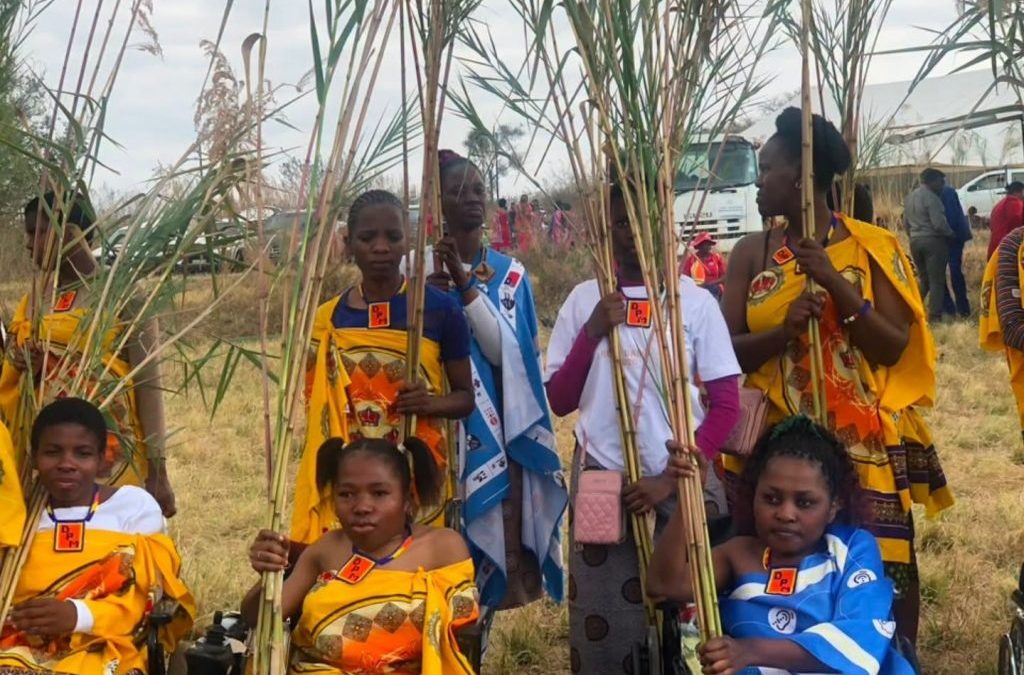
Commenting on iNgwenyama’s humane behaviour towards Sifiso, Dr Hebron Ndlovu, a renowned theologian at the University of Eswatini, said the king embraces the disabled community. He said his behaviour is consistent with his stance of promoting active participation of persons with disabilities in national cultural events such as Umhlanga, Buganu and Incwala. He also described it as buntfu.
“It touched the hearts of many since it signified self-effacement. It must be remembered that one of the emazinyane, who is apparently studying in Taiwan, has a disability. In my view, buntfu in this context means treating persons with disabilities as your fellow brother or sister in the same manner that you would ordinarily relate to non-disabled persons,” Dr Ndlovu said.
Only time will tell if emaSwati will adopt the monarch’s humane behaviour towards people with disabilities and start treating them with respect, dignity, fairness and recognising them as equal members of society rather than objects of curse, pity or charity.