
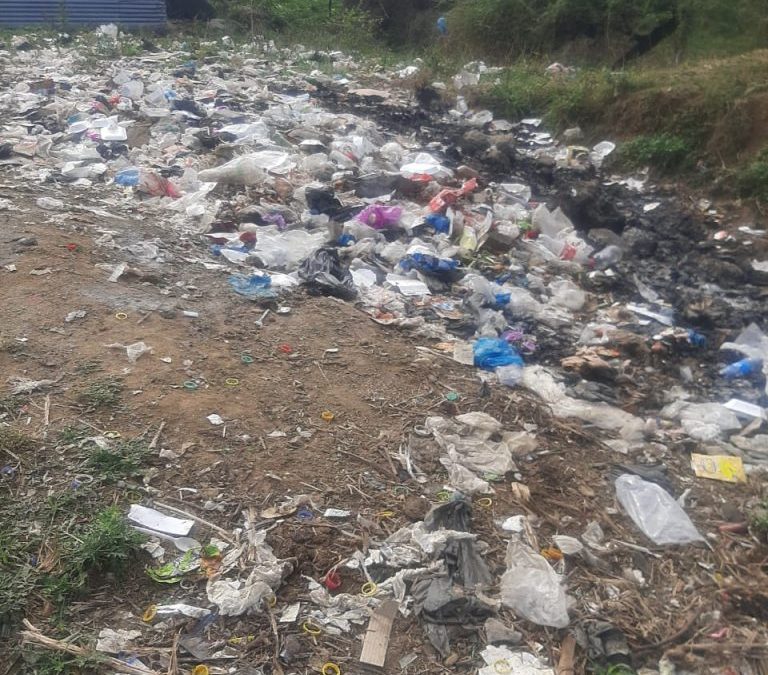
Eswatini is chasing two million visitors by 2027. In Mpaka, a trading hub on the corridor to its game parks and the Mozambican border, the garbage goes uncollected, the law goes unenforced — and the tourism authority will not answer questions. Vuyisile Hlatshwayo reports.
Part 3 of the series “No One’s Job: Eswatini’s Rural Boomtowns”
WHAT TO KNOW
|
MPAKA, Eswatini — I was chatting with *Pierre Kabamba, a Congolese refugee cobbler from the Malindza Refugee Reception Centre, at his clean-swept stall — a sanctuary in the litter-strewn Mpaka commercial hub in the Malindza Chiefdom — when a young man strolled past. Pointing at him, Mr. Kabamba said people walk past his stall all day to dump waste in the nearby pit, or to urinate outside a makeshift plastic toilet reeking of a pungent odour. (Mr. Kabamba asked to be identified by a pseudonym, fearing risk to his refugee status.)
Oblivious of the passersby and of us behind him, the young man urinated on the pile of trash. The moment laid bare the enforcement gap at the Eswatini Environment Authority (EEA), which is empowered to enforce the Environment Management Act, 2002 and the Waste Regulations, 2000 everywhere in the country.
A target from the Throne
Under the Ministry of Tourism and Environmental Affairs, one of the EEA’s core objectives is to protect the aesthetic environment integral to the tourism industry. At his 57th birthday celebration dinner in 2025, King Mswati III publicly directed the government to prioritise tourism as an economic growth driver. He set a target for it to generate E2 billion (about $120 million) in tourism revenue by attracting more than 2 million tourists by 2027. In response, the Eswatini Tourism Authority (ETA), the tourism promotion agency, is driving to position Eswatini as a leading Southern African destination.

Established with one Vukuzenzele shop, now grown into a SaveMor Supermarket owned by the Siteki businessman Moses Motsa, Mpaka boasts commercial services offering automotive parts, grocery shopping, building hardware and financial access. Below it is the bustling Mpaka Railway Station, with living quarters for its workers. According to city-facts, an online data aggregator, Mpaka’s population was estimated at 3,356 in 2015, within Dvokodvweni Inkhundla’s 38,040. Mpaka generated 406 tonnes of waste in 2017, according to a waste management study by the New Delhi-based Centre for Science and Environment.
Mr. Kabamba believes that nothing beats cleanliness to ensure quality health and attract customers and travellers. He said the town-like Mpaka trading centre is strategically positioned: 6.5 kilometres, about four miles, from King Mswati III International Airport, on the MR3 highway to the Lomahasha and Mhlumeni Border Gates with Mozambique, and on the way to Hlane Royal National Park and Mbuluzi Game Reserve.
The mounting trash, he said, drives away travellers who put a premium on clean destinations. Cleanliness is personal for him: he saw what disease outbreaks did in his native Democratic Republic of Congo.
“Nobody wants his dream vacation to be ruined by a pile of garbage.” — Pierre Kabamba
“I sweep this place daily before I start working because of the wind-blown trash from the pit. The uncollected waste scattered throughout Mpaka spoils its beauty and poses a serious health risk to us working here. It also drives away travellers. Nobody wants his dream vacation to be ruined by a pile of garbage,” he said.
Across the MR3 highway, next to the metal stalls at the bus station, a young man with a mental illness rummages through the garbage in an open pit. Near him, food vendors sell braaied, or grilled, meat, home-brewed emahewu — a tangy fermented maize drink — and roasted maize cobs in a place strewn with litter. Only a handful of vendors remain in the sole market structure, a corrugated roof with no walls. Sitting under a kaleidoscope of umbrellas, many vendors sell their wares on the roadside. One of them said they are forced to stay at home in bad weather because they cannot work in a shelter without walls.
“Our place is drowning in waste”
Nokulunga Tsabedze, the chairperson of Mpaka’s Sesikhulile Market, echoed Mr. Kabamba’s concerns about the piles of waste being an eyesore to customers and to travellers going to and from the nature reserves and neighbouring Mozambique. She blamed two things: people’s poor waste management practices, and the EEA’s enforcement gaps in a rapidly growing, town-like trading centre.
“Not punished for littering, our people continue to dump litter anywhere although we have waste pits. We try to preach the gospel of anti-littering to them but most of them just don’t listen. Unfortunately, we don’t have the power to punish them. As a result, one keeps quiet to have peace otherwise you can run mad,” she said.

Ms. Tsabedze acknowledged the EEA’s struggles to introduce a waste management system in Mpaka — until it abandoned the service at the beginning of the 2026-27 financial year, in April, without notice. After a land dispute, she said, the chiefs’ council (libandla) allocated the EEA another piece of land in 2025 to build a legal dumpsite. They were already using it, she added, before the EEA locked the gate, leaving them in the lurch.
“The EEA had organised the community police to collect waste and enforce the anti-littering law. In 2025, it provided a van which collected waste that we put in the waste bags and transported it to the new waste disposal area. To our surprise, EEA has just stopped without giving us a notice. Our place is drowning in waste once again,” Ms. Tsabedze said.
A survey mistaken for a service
Asked about the locked gate and the unannounced withdrawal, Belusile Mhlanga, the EEA’s head of environmental impact assessment, monitoring and evaluation, said the authority had hired enumerators to conduct a survey of the type of waste generated, and of waste segregation, to determine the viability of a buy-back centre in Mpaka. Residents, she said, mistook the survey for a waste collection service.
“EEA hired young enumerators, who were given transport to collect waste from the Mpaka homesteads and trading centre. This was our survey meant to determine the type of waste generated around Mpaka and whether the waste collectors or recyclers could make money from trash. That’s why it just ended when the survey was over. It’s a pity that the residents mistook it for our provision of a waste disposal service,” she said.
Meanwhile, the EEA’s executive director, Gcina Dladla, said Mpaka faces a waste management problem common to commercial nodal areas across the country. The EEA, he said, is playing catch-up because these areas grew without spatial development planning. The authority has designated Mpaka as a waste collection area, he said, and constructed a buy-back centre where residents can recover recyclable trash to realise its value — a benefit of the circular economy.
“We’ve a small problem with the land suitability that umphakatsi (the chief’s royal kraal) allocated us which has forced us to stall the buy-back project. But we are trying to find a quick solution to the Mpaka waste management problem. My team is working on it with the relevant authorities,” he said.
A law low in the pecking order
On the enforcement gaps, Mr. Dladla admitted that the law is not enforced fully everywhere because of a shortage of EEA enforcers on the ground. He attributed this to a lack of coordination with other law enforcement structures, like the Royal Eswatini Police Service. In the law enforcement hierarchy, he said, litter is placed low in the pecking order.
“We are trying to enforce the environment laws everywhere, but the only problem is individuals littering without anyone seeing because we don’t have people on the ground. This is one area that we need to address ensuring that the other law enforcement agents like the police come on board. We piggyback on the community police that we have appointed as litter wardens and given badges in some of these rural areas,” the executive director said.

Three hubs, no local government
Mpaka, Luve and Siphofaneni — the three town-like rural hubs in this series — sit on the crossroads that connect Eswatini to South Africa and Mozambique. None has a local authority responsible for its waste: the single countrywide system of local government promised by Section 218(1) of the Constitution is now 15 years past its deadline.
South Africa and Mozambique send Eswatini most of its visitors: 629,203 and 192,221 arrivals respectively in 2025, up 3.8 percent and 27.8 percent from the previous year, according to the Eswatini Tourism Authority’s published statistics. The country received 1,037,054 visitors in 2025, up from 964,880 in 2024.
Michael Masuku, a Luve businessman who runs Ndlelayekuphila Lodge, called on the government to find a quick solution to the poor waste management threatening tourism businesses in the town-like trading centres. The lack of sanitary services and the litter-strewn places, he said, inconvenience and drive away tourists.
“When the guests go around Luve, they are shocked that it does not have a public toilet and piped water in modern times. This badly affects tourism because they think that our area is not only backward but a health risk. They are forced to cut short their sightseeing tours and rush back to the lodge to use the flushing toilet,” he said.
Mshweshwe Nkambule, a Siphofaneni businessman, shared his Luve counterpart’s concerns. The piles of waste in the rural commercial hubs, he said, are a blight on tourism, painting an unsightly and filthy picture to travellers from eThekwini, in South Africa’s KwaZulu-Natal Province, who use the Lavumisa Border Gate. Luve receives South African visitors through the Matsamo and Mananga Border Gates, while Mpaka receives Mozambican tourists through Lomahasha and Mhlumeni.
On August 10, 2026, Inhlase sent written questions to the ETA’s communications coordinator, Nondumiso Mkhwanazi, about the authority’s role in promoting responsible waste management in the rural commercial nodes, which significantly influences tourism. She had not answered, nor responded to follow-up WhatsApp messages, by the time of publication.
Each morning, Mr. Kabamba sweeps his stall before the first customers arrive — one clean square in a trading hub that the king’s E2 billion tourism target is counting on.
BY THE NUMBERS
|
| RELATED COVERAGE
|
| ABOUT THIS REPORTING This article is Part 3 of an Inhlase series on Eswatini’s rural commercial hubs, which function as towns without town governments. Reporting included visits to the Mpaka trading hub and interviews with vendors, the Sesikhulile Market chairperson, the EEA’s executive director and its head of environmental impact assessment, and businesspeople in Luve and Siphofaneni. One source, a refugee, is identified by a pseudonym because he feared jeopardising his refugee status. The Eswatini Tourism Authority did not respond to written questions sent Aug. 10, 2026, or to follow-up messages. Tourism figures come from the authority’s published statistics; waste figures from the Centre for Science and Environment. |
| HAVE YOUR SAY Is the trading centre nearest you clean enough to bring a visitor to? Tell Inhlase via our Facebook Page or comment below. |