
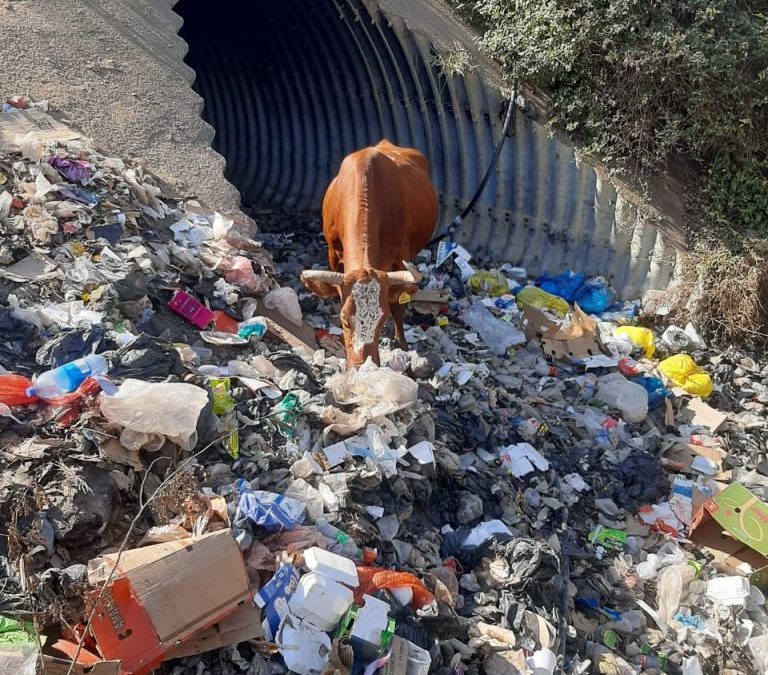
Siphofaneni is functioning as a town without a town’s government. Fifteen years after the constitutional deadline for countrywide local government lapsed, the rural commercial hub is drowning in waste.
By Vuyisile Hlatshwayo
THE STORY IN BRIEF
|
Near the roadside stalls at the Siphofaneni bustling bus rank, the bridge tunnel that has long been used as an illegal dumpsite is piled with waste. As I photographed the pile, a cow wandered into the tunnel and began to eat.
This stands in sharp contrast with the newly built Siphofaneni Plaza, a clean, modernised shopping complex in a litter-strewn rural trading hub, an oasis with a fence line. Inside, manicured landscaping and swept walkways; beyond its perimeter, overflowing drums, bins and wind-blown trash. Owned by MA Properties and the Public Service Pension Fund (PSPF), its waste is trucked to Lanjeni dumpsite, situated 5km away west of the Siphofaneni commercial hub.
On November 18, 2025, the Ludzidzini Council, a traditional body responsible for settling chieftaincy disputes, ended a decades-long Siphofaneni chieftaincy dispute. It resolved that Siphofaneni falls under the jurisdiction of Chief Mgwagwa Gamedze of Madlenya Chiefdom, not Prince Mshengu of KaMkhweli Chiefdom. This settled tensions among the businesspeople pushing the chieftaincy dispute agenda, which hindered development including the provision of waste management services.
A walk through Siphofaneni shows what happens when rapid urbanisation outpaces waste services in Eswatini’s rural commercial hubs, centres governed not by local authorities but by chiefs. Siphofaneni, under the Madlenya Chiefdom, is urbanising fast; its waste disposal has not kept up. Since the 2007 Eswatini census, the population of Siphofaneni has grown from 23,488 to 32,542 according to the 2017 census.
The Eswatini Constitution, promulgated on July 26, 2005 (21 years ago this week) scraps, in Chapter XIII, the rural-urban divide. Section 218 gives Parliament a deadline of five years from its commencement (February 2011) to implement it. Subsection 1 provides for the establishment of a single countrywide system of local government, the tier that would make waste collection somebody’s legal job in places like Siphofaneni.
“Parliament shall within five years of the commencement of this Constitution provide for the establishment of a single country-wide system of local government which is based on the tinkhundla system of government, hierarchically organised according to the volume or complexity of service rendered and integrated so as to avoid the urban/ rural dichotomy.”
But the government, through the Ministry of Tinkhundla Administration and Development, which is responsible for local government in rural areas, has failed to comply for 15 years.


A town in everything but name
Siphofaneni is a hotspot of waste generation: a fast-growing commercial node with a sugarcane town character in the Lubombo region. Situated between the city of Manzini and the industrial town of Big Bend along the Manzini-Lavumisa Road (MR8), it serves as a vital service and trading centre for the surrounding farming communities. It has grown to provide a broader mix of local artisan shops, banking, healthcare, dining, and street vending.
I visited Siphofaneni three times for Inhlase between October 2024 and June 2026 and found a rural commercial hub drowning in waste, posing serious environmental and public health risks. Walking past roadside stalls, I interacted with street vendors, who carried on amid the wind-blown trash, selling second-hand clothes, cosmetics, mobile money, airtime, braaied meat, and fresh fruits and vegetables to passersby and commuters at the bustling bus rank.
A food vendor, Bongani Gamedze, complains about the unsanitary conditions of the place strewn with litter. His food stall is next to a seasonal stream and bridge tunnel that have been turned into an illegal dumpsite.
“All sorts of rubbish is scattered throughout the place which drives away some customers. But we’ve ourselves to blame because some vendors refused to pay a user-fee for a tractor waste collection service,” Gamedze says.
Walking past the shops bordering the emaDladleni (informal kitchens), I found litter strewn within the premises. The walls of the pathway reeked of urine, even though Siphofaneni has a public pay toilet facility near the bus rank. Behind the shopping complex, on the upper part across the MR8 road, I found that some people were using an undemolished pit latrine next to the disused Siphofaneni Handicraft Centre.
Earlier, I visited the now-fenceless Lanjeni dumpsite due to fence theft, which was overflowing with mounds of trash. I regretted not wearing a mask to avoid the heavy, sour odour of rotting items in the air. Overflowing as it is, it remains the Siphofaneni area’s only legal dumpsite under the Waste Regulations 2000.
Dumping waste in an open dumpsite like Lanjeni damages the landscape and poses health risks to humans and animals. Additionally, it produces leachate, a liquid from rotting waste that degrades soil and contaminates groundwater.
Total waste generation in rural and peri-urban areas in Eswatini is estimated at 137,409 tonnes per year, according to a May 2022 report by the Centre for Science and Environment (CSE), a New Delhi-based research body.
The toll: sewage, sickness, missed school
Vusi Ndzinisa, an environmental health officer at Siphofaneni Clinic, deals with the consequences daily. He classifies the waste into two types: solid and liquid.
“The solid waste is composed of papers, plastics and all sorts of trash that is mainly generated by the market and street vendors operating at the roadside stalls. They’ve now turned the bridge tunnel into an illegal dumpsite as they dump their litter there before they go home,” Ndzinisa says.
Liquid waste (wastewater) comes from toilets and restaurant kitchens. Siphofaneni residents, he says, face overflowing septic tanks. He attributes it to unsuitable soil.
The overflowing septic tanks pose a serious public health risk, Ndzinisa says. Overflowing wastewater spills onto business premises and breeds flies, which carry germs to the food-serving places. He links the flies to food poisoning cases.
The rain, he says, washes faecal matter into the Usuthu River, contaminating its water. This causes health problems for people living downstream who drink or come into contact with the contaminated water. They risk waterborne diseases such as diarrhoea.
The environmental health officer says that solid waste collects water, which becomes a breeding ground for mosquitoes that spread malaria. He ranks Siphofaneni as one of the hotspots of malaria in the Lubombo region. The wind-blown papers and plastics, he adds, are a blight on tourism.
According to National Malaria Programme data, Siphofaneni Inkhundla recorded 94 confirmed malaria cases between 2020 and 2025, 79 of them locally transmitted and 15 imported. Cases peaked at 28 in 2023, and 24 were recorded in 2025. The programme cautions that the figures cover the whole inkhundla, not the Siphofaneni commercial hub alone.
A senior teacher at Siphofaneni Primary School, who spoke to Inhlase on condition of anonymity in fear of reprisals, says the waste reaches her classroom.
“During the rainy season, we have a lot of student absenteeism. Students miss classes or return home due to diarrhoeal diseases caused by waste that is washed down to the river, where some draw water for domestic purposes,” she says. “This area is also a breeding ground for malaria due to stagnant water collected in the litter. Because we don’t have a waste collection area here, we use a pit to dump our school litter and burn it.”
Records at Siphofaneni Clinic show 33 diarrhoea cases in May 2026, 43 in June and 22 in July so far, 98 cases in three months, during the dry season before the rains that the teacher describes.

“This waste is no longer manageable”
Mshweshwe Nkambule, a businessman who chairs the Siphofaneni Solid Waste Committee, says the crisis has outgrown his volunteer body. This was set up by the community as an arm of the Inkhundla, empowered by the Waste Regulations 2000. He says the biggest problem is the scattered litter throughout the area. He attributes the unmanageable trash to Siphofaneni functioning as a town without a town’s government.
“In 2023, we notified the Regional Administrator Themba Msibi that this waste is no longer manageable because this place is rapidly urbanising. He advised us to obtain the Chief’s consent before approaching the King for his royal consent to upgrade Siphofaneni to a town because this is on Swazi Nation Land. But our Chief, who is in charge, warned us not to rush for its upgrade to a town and be wary of the social inequalities common in urban areas run by the local authorities,” he says.
Even Prime Minister Russell Dlamini supports the idea of upgrading Siphofaneni to a town to unlock many development opportunities. On August 8, 2024, he called on the Minister of Housing and Urban Development, Appolo Maphalala, to declare Siphofaneni a town during the opening of the Siphofaneni Inkhundla Service Centre. Section 4(1) of the Urban Government Act of 1969 empowers the Minister to declare any area to be a municipality.
Attempts to get a comment from Chief Mgwagwa since November 2024 have proved futile. I visited the King’s Office, his workplace, where his secretary promised to arrange an appointment, but it never happened. I followed up with phone calls and WhatsApp messages, and asked Percy Simelane, the King’s spokesman, to assist, but in vain.
One tractor, one failed landfill
According to Nkambule, under the Eswatini Environment Authority (EEA) Siphofaneni Solid Waste Management pilot project, the Ministry of Tourism and Environmental Affairs, through the EEA, a parastatal under the ministry, built and fenced the Lanjeni dumpsite and donated a tractor with a hydraulic trailer to Siphofaneni Inkhundla to solve the solid waste disposal problem. The committee, he says, runs the project as a business, charging businesspeople and vendors for collection.
The Siphofaneni waste management programme which started in 2002, he says, has collapsed two times, in 2020 and 2026, due to budgetary constraints and tractor breakdowns. He blames some businesspeople and market vendors who are reluctant to pay the waste collection fee, and the lack of Inkhundla financial support to cover its running costs.
“It is difficult to manage it because of financial constraints and tractor breakdown. I reported the latter to the EEA because it now requires E11,000 (about US$650) for repairs. It’s become expensive to run this programme because some businesspeople and market vendors don’t want to pay for waste collection,” he says.
Inhlase has also established that in 2025, at the height of the since-resolved chieftaincy dispute, GlobeCare Foundation, an environmental NGO, failed to win E300,000 (about US$17,900) in funding for constructing a new landfill under the Global Environment Facility (GEF) Small Grants Programme. GlobeCare spokesperson Nompumelelo Ntshalintshali said her organisation could not get a letter of consent for a new landfill site from the feuding chiefs.
Environmental management practitioner Lynn Kota, who chairs the programme’s national steering committee, confirmed the application failed because the consent letter was a critical requirement. In Eswatini, development projects and foreign donor grants do not proceed without the chiefs’ consent.
Nkambule says the Siphofaneni business community is failing to comply with the Environment Management Act of 2002. Section 41(2) imposes a fine not exceeding E100,000 (about US$5,950) for waste dumping while sub-section 5 imposes a fine not exceeding E5,000 (about US$300) for littering. He discloses that one businessman has been threatened with court action for non-compliance. The committee, he says, relies on community police who record and relay the number plates of vans seen dumping trash in the valleys. The committee then confronts the culprits.
“We are afraid of spending sleepless nights because of evil owls’ hoots.” — Mshweshwe Nkambule, Siphofaneni Solid Waste Committee chairperson
“It is not easy to be harsh at a community level such that we use threats as litter wardens. For those who don’t want to listen, we can even report them to the police and escalate the matter to the Chief’s court or other courts. We try to be lenient because we live in the same community. We are afraid of spending sleepless nights because of evil owls’ hoots,” he says, alluding to fears of witchcraft retaliation against enforcers.
A fruit and vegetable vendor, laSikhodze, who asked to be identified by her maiden name for fear of reprisals, rejects the claim that market vendors are behind the litter. She says the vendors have hired their own waste collector who collects their litter four times a week. She says each vendor pays him E30 per day, but she does not know where he dumps the litter.
“Government has been slow”
When sought for comment, EEA executive director Gcina Dladla says the Siphofaneni waste problem was identified as far back as 2002. But the EEA’s Solid Waste Management Pilot Project, worth E500,000 (about US$30,000), has collapsed. He blames uncooperative businesspeople.
“The problem is the businesspeople who did not want to cooperate with us from the beginning. The system was such that the business owners should contribute towards the running costs of the tractor waste collection and hiring people. As I’m talking, the tractor is parked at the police station for safekeeping,” he says.
“As I’m talking, the tractor is parked at the police station.” — Gcina Dladla, EEA executive director
Dladla says it is time for the Ministry of Housing and Urban Development to declare Siphofaneni a town so that it can have a local authority to make it mandatory for the people to manage waste. He says a series of clean-up campaigns is just a drop in the ocean because “the moment you leave, it becomes untidy again.”
Dudu Ndzinisa, Director of Decentralisation at the Ministry of Tinkhundla Administration and Development, acknowledges that government has been slow to implement Chapter 13 of the Constitution on local governance. She attributes this to two things: the back-and-forth process in drafting the Decentralisation Policy and government budgetary constraints.
“Decentralisation is meant to bridge the rural-urban divide. We’ve our Decentralisation Policy ready that we presented to the Cabinet Ministers on June 4, 2026 for approval,” Ndzinisa says. “Local government requires a specific budget to ensure service delivery from the national government to tinkhundla centres and down to the chiefdoms. We’ve piloted Service Centres in a few tinkhundla centres, which the government has since mainstreamed. They’ve a waste management component. Hopefully, our policymakers and the finance ministry will see value for money and add a service centre line in the national budget.”
Siphofaneni got one tractor to haul its waste. It sits, broken, at the police station and the policy that might replace it has been waiting on the Cabinet’s table since June 4, 2026.
THE NUMBERS
|
EXPLORE THE DOCUMENTS
|
| HOW THIS STORY WAS REPORTED Inhlase visited Siphofaneni three times between October 2024 and June 2026, photographing dump sites and interviewing vendors, the clinic’s environmental health officer, a senior teacher, the Solid Waste Committee chairperson, the EEA’s executive director, GlobeCare Foundation, the GEF Small Grants Programme steering committee chair and the Ministry of Tinkhundla Administration and Development. Malaria figures are inkhundla-level data from the National Malaria Programme; diarrhoea figures are from the Siphofaneni Clinic register. Attempts to reach Chief Mgwagwa Gamedze since November 2024 — in person at the King’s Office, by phone, by WhatsApp and through the King’s spokesman — were unsuccessful. |
| HAVE YOUR SAY Does your area have waste collection — and who provides it? Tell Inhlase via our Facebook page or comment below. Poll: Should Siphofaneni be declared a town? Yes / No / Only with safeguards for residents on Swazi Nation Land. |