
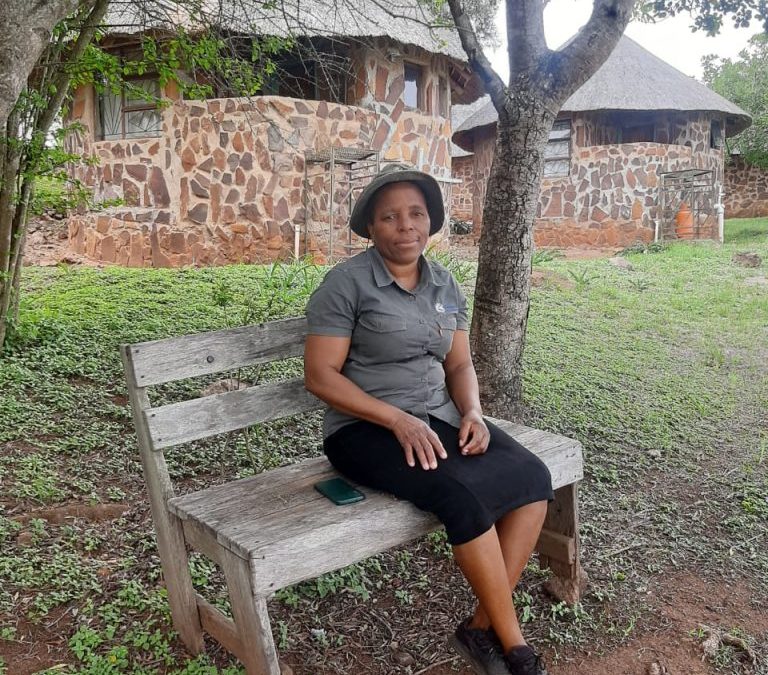
By Vuyisile Hlatshwayo
For community tourism operators in the deep rural eSwatini, climate change is no longer an abstraction but an urgent reality. While still recovering from the COVID-19 pandemic, they now face additional climate change challenges crippling their community-based tourism business. They grapple with the adverse effects of climate change-driven heavy rains that destroy gravel access road networks.
“Climate change remains the biggest challenge to our community tourism business. The gravel road linking Shewula Mountain Camp to the Lomahasha MR3 Road is in horrible condition. Booked tourists using small cars or low-floor buses turn back after travelling a kilometre from the main road due to its years of deterioration and neglect,” explains Thandi Mhlanga, a manager at Shewula Mountain Camp, eSwatini’s oldest community-based tourism outfit established in 1999 and situated in the Lubombo Conservancy.
She adds: “We always ensure that we prepare everything to make their stay here enjoyable. But it is now common for our staff to wait from sunrise to sunset for the would-be non-arrivals. Upon checking emails, one is hit with a visitor’s message saying they couldn’t make it because of the poor condition of our road, which forces visitors to turn back to avoid damaging their vehicles. The booking cancellations have negative effects on our tourism business.”
An Inhlase investigation has established that the deteriorating condition of the Shewula gravel road mirrors the challenges faced by community-based tourism initiatives across the four regions – Hhohho, Lubombo, Manzini and Shiselweni.
Royal directive
Yet King Mswati III has publicly directed the government — through the Eswatini Tourism Authority (ETA), the state enterprise that markets the country’s tourism — to make tourism a driver of economic growth.
In his 57th birthday celebration dinner last year, the king set a 2027 target for the Ministry of Tourism and Environmental Affairs. “Tourism must drive economic growth in eSwatini. To achieve this objective, we need to attract over 1 million tourists per annum and at least 2 million by 2027, which will pump E2 billion in revenue for the local economy,” the king said.
Responding to the king’s Nkwe (Act with Urgency) directive, the Russell Mmiso Dlamini administration, through the Ministry of Public Works and Transport, embarked on a E112 million road rehabilitation programme known as the Emergency Road Rehabilitation Programme in response to heavy rains and storms, which left the road infrastructure severely damaged countrywide in the 2025/26 financial year. In the 2026/27 budget, the government allocated E164 million specifically for feeder-road rehabilitation and maintenance — one line in a road infrastructure package the finance minister put at nearly E2 billion.
Speaking in the eSwatini capital, Mbabane, on 4 September 2025 about the road rehabilitation programme, Minister of Public Works and Transport, Chief Ndlaluhlaza Ndwandwe, assured the nation that restoring accessibility is not only about road safety, but also about reviving economic activity and reconnecting communities.
“Our goal is to ensure that no community is cut off from essential services due to the damaged road infrastructure,” he emphasised.
The minister cited these interventions as part of the ministry’s long-term vision to build resilience against climate-related damage and ensure a safer, more reliable road network for all emaSwati – sparking hope and relief among community-based tourism operators who had been in despair.


No tangible actions
When asked to comment on accessibility since the launch of the road rehabilitation programme, the main community-based tourism operators, who rely on feeder gravel roads to thrive, express disappointment at the ministry’s failure to deliver on its promises and strongly criticise it for a lack of tangible action.
Inhlase contacted five main community-based tourism operations: Shewula Mountain Camp, Mahamba Gorge Lodge, eMvembili Eco-Lodge, Myxo’s Swazi Village Home Stay and Khelekhele Lodge. They all paint a bleak picture of a community-based tourism industry choking on the periphery of mass tourism due to the climate-induced poor rural road conditions.
Shewula Mountain Camp’s Mhlanga complains that the Ministry’s Siteki Roads Depot in the Lubombo region has failed to act on the Shewula community’s multiple requests for road rehabilitation. She noted that the reporting started well before the COVID-19 pandemic. As a result of the ignored road deterioration and neglect, Shewula Mountain Camp has lost many overseas tourists who were bused from Kruger National Park en route to the Mozambican beaches or Durban, the South African tourist mecca.
“Our European visitors’ buses are unable to access this place because of the bad road. We now hire local kombis to pick them up at the turn-off from the main road. We have an arrangement with the Lomahasha police to park their coaches at the police station, 20 minutes away. But many have stopped visiting because the government fails to fix our roads. They have found it too risky and inconvenient to use local kombis. This has cost us dearly because our bookings have dropped sharply, down from 100% occupancy from June to August, when people in Europe are on holiday. Visitors from Italy, the Netherlands, France, Belgium and Germany used to patronise our place,” Mhlanga laments.
On Shewula Mountain Camp Facebook, one visitor, G. Maria from Lima, Peru, warned others: “The place is on the top of the mountain with great views, but the road is a dirt road and stones, so be prepared.”
Road deterioration and neglect
At eMvembili Eco-Lodge in the Northern Hhohho region, chairperson Sheila Sibindzi echoes Mhlanga’s concerns that climate-induced poor road conditions pose a serious threat to community-based tourism operations. She told Inhlase that eMvembili Eco-Lodge, located in a mountainous area, is difficult to reach after rainfall, as the gravel road, riddled with gullies, becomes slippery.
“Following the downpours, our business is temporarily closed. We had two bookings in November and only one in December. All were cancelled because our place is always excessively muddy and inaccessible in the rainy season,” she explains. “Since the beginning of November, we haven’t had a cent due to the lack of visitors.”
Situated 119km from the Kruger Mpumalanga International Airport and 30 minutes away from the Matsamo Border Gate, which provides entry into South Africa’s Mpumalanga Province, the eMvembili Eco-Lodge is attractive to emaSwati in Mpumalanga and overseas tourists visiting the iconic Kruger National Park. But poor road conditions remain a barrier on the eSwatini side.
“Interested emaSwati tourists make enquiries from Mbombela and the Matsamo Cultural Village when it’s fully booked. But they end up not coming up here when they learn about our poor road conditions,” she says.


Sibindzi points out that their road reports to the eMvembili Chiefdom’s Constituency Development Officer, who is supposed to liaise with the Ntfonjeni Inkhundla MP and the Piggs Peak Roads Camp, have been ignored. She noted that government trucks would come to offload piles of gravel onto the road, but no grader or worker would then follow to spread it across the road to fill the widening gullies and dongas.
David Dlamini, a youth representative in the Mahamba Gorge Lodge Trust in the Shiselweni region, shares the same sentiments: “The stretch of gravel road from the turn-off of the tar road towards Mahamba Border Gate to here is just horrible. Only visitors driving 4X4s, not your sedans, reach this place due to the gullies caused by the poor drainage system. Whenever we approach the Nhlangano Roads Depot, they always make excuses about the shortage of diesel for the government graders and trucks.”
Khelekhele Lodge’s Makhosi Dlamini, a representative of Velezizweni Royal Kraal (Umphakatsi), echoes these frustrations in the Manzini region, highlighting that the eco-lodge on the banks of the Ngwempisi River is inaccessible via the Mankayane gravel road due to its poor condition. “We’ve tried to hire the herd-boys to fill the gullies with stones. Visitors avoid coming here because of the bad road condition, which becomes worse after heavy rains,” he says.
His counterpart, Bobo Dlamini, from Myxo’s Swazi Village Home Stay, situated in KaPhunga in the same region, praised KaPhunga Inkhundla MP in the 12th Parliament for grading the gravel road after years of deterioration and neglect. He, however, hastens to add that the road is bad due to the heavy rainfall. “You need a 4×4, and it is hard with a small car unless you’re an experienced driver. We don’t get booking cancellations, but they have their cars damaged by the time they arrive here because of the gullies and dongas,” Dlamini says.
Without govt support
Mahamba Gorge Lodge’s Dlamini (David) noted that the feeder roads leading to community-based tourism enterprises were excluded from the government’s E1.6 billion probase project. He claimed that the probase asphalt technology could have upgraded their gravel roads to durable, all-weather ones, which are critical for fostering economic development in rural areas. He wondered what criteria were used to select the project beneficiaries.


In August 2014, the government signed a Memorandum of Understanding (MOU) with Probase Swaziland (Pty) Ltd, a subsidiary of the Malaysian Probase Group of Companies. Under an August 2014 agreement, it built a 6km pilot road on Mdzimba Mountain; the government later commissioned about 200km of rural road upgrades, financed by a loan of roughly US$100 million (about E1.6 billion).
Inhlase sought clarity on the exclusion issue from Thulani Mkhaliphi, the principal secretary in the Ministry of Public Works and Transport. He has neither responded to questions nor to follow-up messages sent via WhatsApp since 10 November 2025. Inhlase sent him follow-up questions on June 7 via WhatsApp, which were only blue-ticked but unanswered by the time of publication.
Attempts to obtain comments from Minister of Tourism and Environmental Affairs, Jane Mkhonta-Simelane, proved futile. She had also not responded to questions sent via WhatsApp on 10 June regarding the steps taken to address the challenges faced by the community-based operators at the time of publication.
Yet, chairman of the Parliament’s Portfolio Committee on Tourism and Environmental Affairs, MP Welcome Dlamini, says the minister’s role is to further and safeguard the interests of community-based tourism operators at the weekly meetings of cabinet ministers at Hospital Hill, where she sits with the Minister of Public Works and Transport. He says his committee can only support her when she canvasses support in the House of Assembly.
Read more: Eco-tourism project left taxpayer E1.2m poorer.
ETA communications coordinator Nondumiso Mkhwanazi acknowledges that heavy rains wash away gravel roads, limit accessibility, disrupt visitor movement, and increase operational costs for community tourism enterprises in remote areas. She points out that the ETA has engaged the Ministry of Public Works and Transport to rehabilitate the deteriorating gravel roads leading to several community-based tourism sites.
“While the ETA is not the authority mandated to construct or maintain road infrastructure, we play a strong advocacy and coordination role. The government recognises that these roads form critical economic corridors for rural development, and efforts are underway to improve regular maintenance and long-term surfacing solutions where feasible,” she says.
The community-based tourism operators further raise concerns about the lack of government support for their business. They complain that the government hosts its meetings and workshops in urban hotels and private lodges, reinforcing the perception of a Cinderella community-based tourism sector. Yet they also have conference facilities and need the government’s business support.
“This raises serious questions about the sincerity of our government’s commitment to empowering emaSwati economically in the rural areas. Government’s words don’t seem to match actions in our case,” Mhlanga notes.
A Cinderella of the tourism industry
On participation in the Tri-land Initiative between the Eswatini Tourism Authority (ETA), the Mpumalanga Tourism and Parks Agency (MTPA), and Mozambique’s National Tourism Institute (INATUR), which promotes the Southern Africa region as an integrated tourist, trade and investment destination, the community-based tourism operators complain that ETA favours and showcases the mass tourism players.
Sibindzi notes that ETA leaves out eMvembili Eco-Lodge from its MTPA and INATUR in-country itinerary. Yet it is the first stop for those entering Eswatini through the Matsamo Border Gate from Mbombela in the Mpumalanga Province. Mhlanga, her counterpart, adds that the ETA invited Tri-land representatives and tour operators have never set foot in Shewula Mountain Camp. After visiting Hlane Royal National Park, they always bypass Shewula Mountain Camp and shoot straight to the Lomahasha Border Gate with Mozambique, on their way to the Mozambican beaches.


The ETA communications coordinator argues that community-based tourism historically faced challenges such as limited funding, access constraints, and capacity gaps. She points out that ETA has established a National Community Tourism Association (NCTA) to facilitate their participation in these tourism marketing initiatives. It also seeks, she adds, to explore and implement measures to ensure they are market-ready for participation in source markets.
“We acknowledge the gaps, but we are equally confident that community-based tourism is entering a new chapter of growth, empowerment, and visibility within Eswatini’s tourism landscape. Government and ETA have placed strong emphasis on repositioning this segment as a key driver of rural development, cultural preservation, and inclusive economic participation,” Mkhwanazi says.
Shewula Mountain Camp’s Mhlanga calls on the government to upgrade gravel access roads to durable, climate-resilient roads to address economic inequality caused by rural exclusion from tourism markets and to ensure tourists can physically reach community-based tourism sites.