
Third in an Investigative series on the Harloo Private Reserve cross-border conflict. Part one: “The fence that isn’t: Wildlife, disease and neglect on the SA-Eswatini border” (Inhlase, 1 April 2026). Part two: “Abandoned by the State: Living alongside wildlife, bearing the costs” (Inhlase, 6 May 2026).
By Vuyisile Hlatshwayo
A donor-funded garden run by 11 women in eChibini near Lavumisa has stood idle since 2025 after repeated wildlife raids destroyed crops and made farming impossible, according to its members. The women say the animals crossed from the direction of Harloo Private Reserve in South Africa, leaving them without food, income or compensation.
Inhlase has established that the regulatory failure on the Eswatini-South Africa boundary fence at Lavumisa — previously reported in this series — has dispossessed rural women of a community garden funded across three decades by two international donors, in a manner that engages obligations under treaties Eswatini has ratified and has not implemented. The South African Director-General of Agriculture, the sole official empowered under Section 18(1)(a) of South Africa’s Animal Diseases Act of 1984 to authorise the fence alteration at the centre of this series, had not responded to written questions emailed to the national coordinator of Lubombo Transfrontier Conservation Area at the Department of Forestry, Fisheries and the Environment by the time of publication. Eswatini’s Department of Veterinary Services, which holds a parallel statutory duty under the country’s Fencing Act of 1904 to clear bush along the same fence for patrols, is not performing that duty; its state veterinarian has told this reporter she was not aware the fence had been repurposed.
This story finds that:
- The Phakamani Bomake Community Garden, founded by Lutheran Development Services in 1995 and rehabilitated by World Vision Eswatini in 2023, has been farmed by none of its eleven members since the 2025 farming season because of wildlife crop raids crossing through the broken border fence from Harloo Private Reserve in South Africa.
- The country’s traditional wildlife-conservation doctrine — tilwane teNkhosi, wildlife understood as the King’s property — held the women out of any complaint process for years, during which no government office and no chiefdom authority recorded the dispossession.
- The dispossession engages Articles 14(2)(g) and 14(2)(h) of the Convention on the Elimination of All Forms of Discrimination against Women, Article 11 of the International Covenant on Economic, Social and Cultural Rights, and the property and non-discrimination provisions of the 2005 Eswatini Constitution. Inhlase has been unable to identify any documented government action to meet those obligations in this case.
- The principal secretary of Eswatini’s Ministry of Agriculture, the indvuna of the chiefdom in which the garden falls, the chairs of two parliamentary portfolio committees, the owner of Harloo Private Reserve, the South African national coordinator of the Lubombo Transfrontier Conservation Area, and the communications manager of Ezemvelo KZN Wildlife have all either acknowledged the problem and failed to act, or have not responded to written questions.
The statute on one side of the wire, the silence on the other
The Eswatini Game Act of 1991 protects wildlife with criminal penalties. For example, a person who kills protected game without authorisation must replace the animal or compensate its owner for its full replacement value and may receive a prison sentence of between two and six years. However, when the wildlife destroys crops and attacks livestock and people, the same Act does not provide for compensation to communities. Inhlase reported in early May that no such mechanism exists anywhere in Eswatini laws.
Across the boundary, Harloo Private Reserve markets the same animals to international hunters in US dollars. The reserve’s published price list, reproduced in Part 2 of this series, prices a bush pig at US$580 and a Cape buffalo at US$8,950.


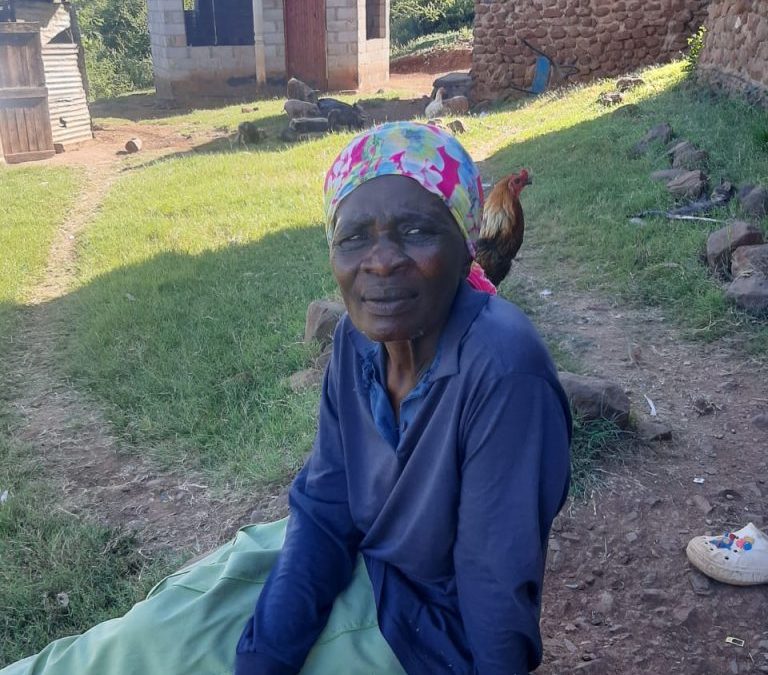
Phakamani BoMake community garden founding member Siphiwe Gina and abandoned garden
The asymmetry has a documented gendered face at Phakamani Bomake Community Garden.
Phakamani Bomake Community Garden — “stand up, women” — was registered as a farming cooperative in 1995 after the 1994/95 drought, founding member Siphiwe Gina said. Lutheran Development Services paid for the original perimeter fence, a borehole and farming training.
In 2023, World Vision Eswatini (WVE) paid the borehole’s electricity connection fee, replaced the perimeter fence after it was stolen, and installed a drip irrigation system, according to WVE communications and campaigns manager Lungile Zwane. The drip irrigation infrastructure remains in place. However, as marauding animals wreak havoc in the communities, no crops have been grown beneath for the whole year.
Asked by Inhlase whether WVE acknowledges that its 2023 investment has been lost due to wildlife incursions across an international boundary fence, Zwane said: “This was especially the case in winter, when grass and trees dried up on the game reserve side and the garden looked green and inviting. The World Vision team on the ground is planning some engagements with the group and the Inkhundla leadership to discuss alternative initiatives that can be done on the land, which will not be at risk of getting damaged by the wildlife.”
Eleven members were on the garden’s roll at the time it ceased operations. None have planted since.
Annah Nyawo, a member, said the project is no longer viable. “It’s our source of survival. We would still harvest something even during the dry spells. But we are unable to guard our crops at night, when the animals come.”
Tilwane teNkhosi: the doctrine and the silence
The eleven affected women did not report the destruction of their garden to the police, to the chief’s indvuna, or to any government office for an extended period. Siphiwe Gina, one of the founding members said, is not that the women were unaware of the losses. It is that they assumed they had no standing to complain.
“When the game established a presence in our forest, we thought tilwane teNkhosi,” Gina said. “We could do nothing then. We couldn’t distinguish between royal game and not-royal game.”
Tilwane teNkhosi — “the King’s animals” — is the SiSwati framing under which all wildlife in Eswatini is understood to belong to the monarch. Combined with the Game Act of 1991, which criminalises unauthorised killing of game, the doctrine operates as a documented disincentive against any community attempt to defend crops or livestock against wildlife. Conversely, the same doctrine has worked to protect wildlife against poaching. Inhlase has been unable to identify any public statement by the King’s Office or the Big Game Parks Wildlife Authority addressing whether tilwane teNkhosi extends to wildlife on privately operated cross-border reserves.
The animals raiding Phakamani Bomake Community Garden were eventually identified as escapees from Harloo Private Reserve, a hunting and tourism operation in KwaZulu-Natal’s uPhongolo Local Municipality. By the time the women understood the source, they did not know how to reach the owner. “We don’t even know where to find the South African game reserve owner across the border,” Gina said.
The owner, Edmond Rouillard, has not responded to Inhlase’s written questions in this series or in any prior instalment.


Women Parliamentary Caucus chair Sen. Dr. Linda Nxumalo and Portfolio Committee chair MP Dr. Bonginkosi Dlamini
The Eswatini-side default
Section 18(1)(a) of South Africa’s Animal Diseases Act of 1984 — the apparent breach of which by Harloo Private Reserve was established in Part 1 of this series — is not the only statutory failure on the Lavumisa fence.
Section 27 of Eswatini’s Fencing Act of 1904 empowers the country’s cordon guards to clear bush within one and a half metres of either side of the boundary fence to permit patrols. The bush on the Eswatini side of the Lavumisa stretch has not been cleared. Wildlife crossing from Harloo has established habitat in the uncleared bush, including in the forest adjoining the Phakamani Bomake garden.
The state veterinarian responsible for monitoring the cordon fence nationwide, Dr Thembi Ndlangamandla, was interviewed on 20 January 2026 on whether the Department of Veterinary Services is complying with Section 27 on the Lavumisa stretch and whether her department was aware that the fence had been repurposed as a game fence by Harloo. She said she was not aware that the fence had been repurposed.
The chain of obligation
Sibusiso Nhlabatsi, principal legal clinic officer at the University of Eswatini Legal Aid Clinic, said the dispossession engages obligations on both sides of the border.
Under Article 14(2)(g) of the Convention on the Elimination of All Forms of Discrimination against Women, to which Eswatini is a state party, the country is obliged to ensure rural women’s equal treatment in land and agrarian reforms. Under Article 14(2)(h), it is obliged to ensure their right to adequate living conditions. Under Article 11 of the International Covenant on Economic, Social and Cultural Rights, also ratified, it is obliged to ensure the right to food. Under the Eswatini Constitution of 2005, it is obliged to protect property rights without discrimination.
“The fact that it is specifically a group of women who have been dispossessed of productive land use is not coincidental in a society where women’s land access is already structurally precarious,” Nhlabatsi said.
Echoing Nhlabatsi’s words, Zakithi Sibandze, national co-ordinator of the Swaziland Rural Women’s Assembly (SRWA), a grassroots feminist movement promoting food sovereignty and seed preservation, raised concerns about the sincerity of authorities’ commitment to achieving food security. She argued that if they were truly committed, they would have supported the rural women who had shown incredible strength in building a garden from the ruins of a drought.
Sibandze noted: “To have this vital project destroyed by wildlife means no food; no income for their families.”
One Billion Rising (OBR) Africa regional coordinator Colani Hlatjwako shared similar sentiments about the government’s failure to address wildlife incursions destroying women’s livelihoods in eChibini. She strongly criticised the authorities for prioritising wildlife welfare over citizens’ welfare.
“We cannot say we’re protecting nature by destroying emaSwati livelihoods. We all know that women not only feed their own families but also the entire communities. It’s important for the government to find a quick solution to this livelihood problem,” she said.
Women’s rights advocates criticised the authorities for paying lip service to food security and women’s empowerment. Senator Dr Linda Nxumalo, Women Parliamentary Caucus (WPC) chairperson noted that the reversal of hard-won gains in poverty reduction and food security is evident in the collapse of Phakamani Bomake Community Garden.
“There must be strengthened cross-border collaboration to address wildlife management along the shared boundaries. The affected women must be supported through targeted recovery programmes, including access to inputs, financing, and technical assistance to restore their agricultural activities,” she said.
Harloo Private Reserve, on the South African side of the border, is subject to South African common-law liability for damage caused by animals under its control that escape onto neighbouring land — the doctrine of sic utere tuo, which Nhlabatsi raised in Part 2 of this series. A civil damages claim in the South African courts is, in principle, available to the Phakamani Bomake members. The Eswatini state’s own obligation, however, is not contingent on whether such a claim is brought.
“The affected Lavumisa community ought to explore whether a civil damages claim in the South African courts against the reserve operator is competent, bearing in mind questions of jurisdiction and enforcement across the border,” he said.
Nhlabatsi pointed out that the transboundary character of this conflict adds further complexity. He noted that, since the reserve is situated on the South African side of the border, its owner is subject to South African law and common law liability for damage caused by wildlife under its control that escapes onto neighbouring land.
But he insisted that the Eswatini government cannot evade its obligations by pointing to the reserve’s cross-border private character. He argued that the state bears responsibility for ensuring that communities are not left without legal recourse when their productive assets are destroyed by forces connected to commercial wildlife operations.
“The affected women’s community deserves, at minimum, immediate interim relief in the form of material assistance; they deserve transparent engagement on the fencing failure; and they deserve access to a functioning, affordable compensation mechanism — none of which appears to have been provided,” he argued.
The record of inaction
Principal Secretary in the Ministry of Agriculture Sydney Simelane has acknowledged on record that the ministry is aware of recurring wildlife crop damage in Somntongo Inkhundla. He has acknowledged that the ministry has not formally requested the Ministry of Foreign Affairs and International Cooperation to raise the matter with South Africa. In a separate interview previously reported in this series, Simelane characterised the Harloo fence as “a serious issue — it is causing hunger and undermining food security for emaSwati trying to improve their livelihoods.”
The acknowledgment has not produced documented action.
Mzingeli Phakathi, indvuna of Vikizubuko Royal Kraal, said he was not aware that the women of Phakamani Bomake Community Garden had abandoned their plots because of wildlife, and that they had not approached the authority.
Phakathi claimed ignorance: “I’m not yet aware of any eChibini women who have abandoned their garden due to crop raiding by wildlife from a nearby game reserve. Perhaps, they are yet to come and report it to Indlunkulu.”
In reporting for Part 2 of this series, Phakathi confirmed that other residents in the same chiefdom did formally approach the traditional authority — for a letter authorising them to kill raiding wildlife — and that the authority refused that request.
Senator Dr Linda Nxumalo, chair of the Women Parliamentary Caucus, said the abandonment of the garden represents a reversal of hard-won gains in poverty reduction and called for “strengthened cross-border collaboration between Eswatini and South Africa to address wildlife management along the shared boundaries”. The Women Parliamentary Caucus has not produced a documented policy submission on the matter.
Rudzani Mudau, national coordinator of the Lubombo Transfrontier Conservation Area at South Africa’s Department of Forestry, Fisheries and the Environment, was emailed and did not respond. Musa Mntambo, communications manager at Ezemvelo KZN Wildlife, was asked whether Ezemvelo has authority to authorise Harloo’s use of the international boundary as its game fence; he declined to comment and referred Inhlase to Mudau. The chair of Eswatini Parliament’s Agriculture Portfolio Committee, MP Dr Bonginkosi Dlamini, and the chair of the Eswatini Tourism and Environmental Affairs Portfolio Committee, MP Welcome Dlamini, were reached for comment via WhatsApp and did not respond.
It is unclear whether Harloo Private Reserve has the authority to use the international boundary as a game fence. Section 18(1)(a) of the South African Animal Diseases Act 1984 empowers only the Director General of Agriculture to erect, alter, or use an international boundary fence to control the movement of livestock and wildlife.
Subsection 7(a) further states that no person may, without written authority from the director general, remove, alter, or impair the effectiveness of any such fence. Subsection 8 stipulates that any fence erected along international boundaries is deemed to have been established for controlled purposes under the Act to contain the spread of animal diseases.
By altering the boundary fence to its game fence, the Harloo Private Reserve has rendered it ineffective. As a result, wildlife crop raiding is rife in the bordering eChibini subsistence farming community, exacerbating food insecurity and poverty. The crop raiders have found new habitats in the bushes on the outskirts of the game reserve.
A field visit by this journalist established that the women-run garden is too close to the reserve perimeter fence. Observations from the half-day tour confirmed that the game fence was made of barbed wire and two strands of electric wire. Senzo Dlamini, a local guide, helped me identify gaps and holes in the fence that allowed wildlife to escape.
According to the Ezemvelo KwaZulu-Natal Wildlife fencing requirements for game reserves, Harloo Private Reserve fencing does not meet them. A document shared via email by Ezemvelo KZN Wildlife manager: communications, Musa Mntambo says the requirement is a minimum of three strands of electrified fencing running on offsets off the main fencing facing inwards with a minimum of 5,000 volts throughout the system – no cable or buffer fence required.
On human protection, Ezemvelo KZN Wildlife fencing guidelines provide for the protection of rural communities living on the outskirts of game reserves with dangerous game, to mitigate human-wildlife conflict.
Food Insecurity Threatens Livelihoods while Authorities watch
As authorities continue to disregard the critical issue of food security, affected women feel forced to abandon the garden project. Repeated wildlife crop raiding made their farming unprofitable. Bush pigs, warthogs, monkeys and other unknown animals consumed and trampled crops, reducing income and food availability.
According to the 2024 Vulnerability Assessment and Analysis (VAA) Report, which quantifies the extent of food insecurity in households, approximately 3,236 people faced food insecurity between June 2024 and September 2024 in Somntongo Inkhundla. This was projected to rise to 3,827 between October 2024 and March 2025. Using the Integrated Food Security Phase Classification (IPC), they were classified in Phase 3 (Crisis) and Phase 4 (Emergency), respectively.