
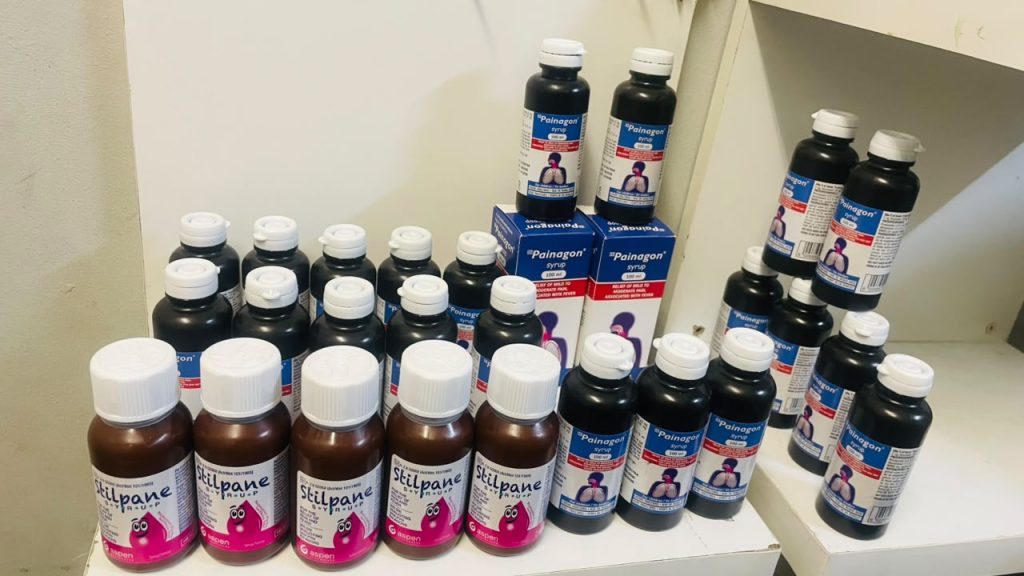
Thirteen years after the Ministry of Health admitted that young people were abusing codeine cough syrup, an Inhlase reporter bought 13 bottles over the counter in Piggs Peak, Mbabane, Matsapha and Manzini. One long-term user describes the dependence that began at high school in 2010 — and has not ended.
By Inhlase Reporter
Inhlase Centre for Investigative Journalism
WHAT TO KNOW
|
In 2013, Dr Velephi Okello, now the Ministry of Health’s Director of Health Services, acknowledged that cough syrups containing codeine, a highly addictive opioid, were being abused by young people.
At the time, while writing an article on codeine syrup abuse for the Eswatini Observer, this reporter spoke to pupils, parents and teachers, tracing the misuse of the medication back to 2009, when codeine had gained popularity among high school pupils.
During that initial investigation, parents, teachers and young people told this reporter that the medications were easily obtained from local pharmacies, and users were mixing the syrups with Sprite for its depressive effects.
That article was published for the Eswatini Observer in 2013.
Now, 17 years after the syrups took hold among pupils — and 13 years after the ministry’s admission — this reporter returned to pharmacies in Piggs Peak, Mbabane, Matsapha and Manzini to re-investigate the matter.
A human voice
A codeine syrup user, identified here as Sandile to protect his identity, told this reporter on Monday 7 September 2026 that his dependence on codeine syrup began while he was still at high school in Mbabane in 2010.
“It started with my friends. We didn’t have enough pocket money to buy alcohol, so we copied the seniors by buying Stilpane syrup from the pharmacy. Back then, it cost only E30. We would mix the syrup with Sprite and drink it at the park.”
Sandile said all the private schools had groups of boys using the medication daily.
“Initially, it was just one bottle mixed in a two-litre shared amongst four guys. Then we moved to two bottles mixed in a two-litre bottle of Sprite because one bottle was no longer strong enough. After a few months, I started buying a whole bottle for myself to enjoy at home, all alone before I went to bed,” he said.
Sandile said the syrup gave him and his friends the feeling of drowsiness and happiness.
“We didn’t have enough pocket money to buy alcohol, so we copied the seniors by buying Stilpane syrup from the pharmacy. Back then, it cost only E30.” — ‘Sandile’, codeine syrup user since 2010
“Before I began using Stilpane, I could sleep normally. But when I didn’t have the syrup, I couldn’t sleep. I would become restless, sick and tired the next day,” he said.
Sandile said that over the span of two years he couldn’t function without syrup and he was heavily dependent on it for his physical and mental health.
“When I didn’t have money for syrup I would worry constantly about the upcoming headaches, diarrhoea and insomnia that were all painful symptoms of codeine withdrawals. I would fear going to bed,” he said.
Sandile said eventually he would do anything for money to buy the syrup.
“I would do anything even steal from my own mother eventually when I raised money, either by begging, stealing or by selling my clothes, I would find that some pharmacies were out of stock because other young people had bought the syrup,” he said.
Sandile said that when there was no syrup in the various pharmacies around Mbabane he would travel to Matsapha, Manzini even to Piggs Peak or Siteki for it, placing a strain on his finances in the process.
“Without the medication, I felt sick. I would vomit, have diarrhoea and suffer terrible headaches. I would also lose my appetite and experience severe insomnia. So I had to travel to find the syrup. It was better than being sick,” he said.
Sandile said his addiction finally landed him in hospital in 2014.
“One time, when I couldn’t find the medication, my pharmacist told me to try the tablets instead, but I became sick after overdosing on the tablets. I went to the Mbabane Clinic and was admitted because of my overdose. My mother was crying. At the time, my doctor told me that my liver was suffering because of my addiction,” he said.
“I am lucky that my mother has the means to afford the Mbabane Clinic and at the time I promised to stop using, but I continued using. Even after my stay at the Mbabane Clinic, I continued secretly using the syrup without my parents’ knowledge. I eventually got a job, but I still continued using from 2010 to 2026,” he added.
“When I asked my friends if they still used it, some said they used it occasionally, while others said they had stopped. Right now, I have a damaged liver and have developed severe diarrhoea and dental issues because of the constant syrup abuse,” he said.
Sandile said he is constantly sick and is trying to avoid the syrup which is very hard to do.
“Over the years, doctors explained to me that the reason why I needed codeine every day was because it leaves the body quickly, in about eight hours, so I would need to keep taking it to stay high, otherwise I would start feeling sick,” he said.
“Today, younger guys are using it, and I wish I could tell them not to. But it is difficult because it is cheaper than alcohol — or at least it was cheaper than alcohol. Back in 2010 it was a ‘cheese boy drug’ (cheese boy is Eswatini slang for a boy whose family is financially well off). Now multiple pupils from multiple schools use it. Because I am not the only one,” he said.
Sandile encouraged this reporter to visit the park in Mbabane on any day to witness the large number of high school pupils drinking syrup.
“I still drink it and I am not the only one buying it at the pharmacies. The main syrups now are Painagon, Stilpane and Lenazine for me. I can no longer find Salterpyn syrup. Back in 2013 to 2024 it became a famous substitute for me and my friends when Stilpane was out of stock,” he said.
“Stilpane is the original for us so it would sell out very quickly; in its absence many pharmacists would recommend Salterpyn instead. Also, initially we had to rotate the pharmacies in Mbabane where we purchased because some pharmacies like Clicks started demanding prescriptions after our frequent visits,” he said.
“I think it is because they noticed us, so we started to visit different pharmacies because we didn’t have the prescriptions. When we started it was easy to find the syrups; now it is getting harder because all these younger kids are finishing it,” he claimed.
“Because of this addiction I wish I was dead, because it is painful being addicted,” he concluded.
| HELP FOR PEOPLE EXPERIENCING MEDICINE DEPENDENCE
People struggling with dependence on medicines or other substances can seek professional help from the National Psychiatric Referral Hospital in Manzini on +268 2505 5170. The Association of Students Against Drug Abuse and Trafficking (SADAT), which provides counselling and advice on drug abuse, can be contacted on +268 2404 1077, +268 7611 5858 or +268 7647 3079. The Phumelela Project in Manzini also provides counselling and psychosocial support for drug and substance abuse. Its published contacts are +268 7854 0144, +268 7989 3525, +268 7631 7827 or +268 2505 2407. |
What are the syrups?
According to pharmacist Simphiwe Dlamini at Health First Pharmacy in Manzini, local pharmacies sell six types of cough syrups containing codeine to members of the public.
Currently, according to Dlamini the most popular syrups are Painagon, Stilpane, Astra Pain, Lenazine and Benylin with Codeine.
Each syrup is sold in 100 mL bottles.
At the time of writing, Dlamini stated that to the best of her knowledge Salterpyn syrup was discontinued by its manufacturer in South Africa hence it is no longer available in Eswatini.
Dlamini explained that most of the aforementioned syrups are very popular among the youth and are liquid preparations marketed for the relief of pain and fever.
“The formulation identified for Painagon, Astra Pain and Stilpane is 120 mg paracetamol, 5 mg codeine phosphate and 6.5 mg promethazine per 5 mL, together with 12.5% alcohol,” she said.
“A 100 mL bottle therefore contains approximately 100 mg (0.1 g) of codeine phosphate in total, 2.4 g of paracetamol and 130 mg of promethazine. While Stilpane contains no alcohol. In South Africa and at Clicks pharmacies here in Eswatini the codeine cough syrups in question according to the manufacturers are classified as a schedule 2 medication due to the codeine concentration,” she added. In South Africa, however, Schedule 2 medicines may be sold by a pharmacist without a prescription — the registered patient leaflet for Stilpane states it “is available without a doctor’s prescription” — though scheduled medicines may not be displayed for open self-service.
Dlamini concluded by saying that going by the manufacturer was better than assuming a medication’s schedule.
“In Eswatini we often go by the manufacturer’s recommended scheduling of the medication; that is a safer baseline for medication scheduling,” she concluded.
South African reporting has also documented concerns around codeine misuse, including reports of teenagers seeking treatment for codeine addiction, accounts of codeine-containing medicines being easily obtained by young people, and more recent efforts to strengthen monitoring of codeine sales, as reported by the Sunday Times in 2019, Daily Maverick in 2022 and TimesLIVE in 2024.

Test purchases
To test how easy it is to obtain the medications in Eswatini, on Monday 20 July 2026 in Piggs Peak this reporter bought four bottles of Painagon at E50 a bottle, spending E200 at Connection Pharmacy, with no questions asked by the pharmacist.
The reporter walked into the pharmacy, saw the bottles on the shelf and asked to buy two; after telling the pharmacy assistant that he had travelled from Mbabane and needed more, the assistant allowed the addition of two more bottles.
The batch number on the side of the bottles is BTH0379A on all four.
The date of manufacture on all four bottles is 06/2026 and the expiry date 07/2028.
According to the warning label, Painagon is a Schedule 2 (S2) medication that, with prolonged and continuous use, can lead to dependency and addiction.
On the same day in Mbabane, the reporter bought three bottles of Stilpane at once, totalling E150, also from the Mbabane branch of Connection Pharmacy, with no questions asked.
The Stilpane batch numbers on the bottles are E0030618, E0030617 and E0030888.
The expiry date on all three is 05/2027.
The Stilpane bottles carry no date of manufacture.
The Stilpane warning label also states that the medication is a Schedule 2 medication and warns users not to exceed the recommended dose, as prolonged use could lead to dependency and addiction.
During the purchase in Mbabane, one of the employees said the medication was usually bought by high school pupils, especially on Fridays.
“Today, younger guys are using it, and I wish I could tell them not to. But it is difficult because it is cheaper than alcohol.” — ‘Sandile’
Next, in Matsapha on Wednesday 22 July 2026, this reporter bought three bottles of Astra Pain, totalling E165, from YHM Pharmacy at Sigodvweni.
This came after the pharmacist recommended Astra Pain because both Painagon and Stilpane were out of stock.
The Astra Pain was also bought with no questions asked, and the pharmacist offered to sell more, but finances would not allow further purchases that day.
The batch numbers on the Astra Pain are B9314915, B9314915 and B9314911.
The date of manufacture on all three is 04/2026 and the expiry date 04/2028.
Astra Pain is also listed as a Schedule 2 medication on its packaging.
In Manzini on Thursday 23 July 2026, three bottles of Painagon were bought for E150 from Ludwala Pharmacy in Zakhele.
The batch number on all three is BTH0178A.
The date of manufacture on all three is 06/2026 and the expiry date 05/2028.
This purchase was also made without any questions asked, and the medications were openly displayed on the shelves.
In Mbabane, Matsapha and Manzini, cashiers invited this reporter to come back to make more purchases, as the medication often sold out quickly.
Pharmacies in Piggs Peak, Mbabane, Matsapha and Manzini that did not have the syrups in stock advised this reporter to buy the medication in tablet form instead, saying the tablets would produce the same drowsy effect.
The suggestion to use tablets mirrors Sandile’s account of his own experience.
In 2014, when he could not find syrup, a pharmacist advised him to try the tablets instead.
That substitution led to his overdose and admission to the Mbabane Clinic.
In all, this reporter bought 13 bottles of syrup in four towns between 20 and 23 July 2026, spending E665. The receipts and bottles were retained and photographed.
What the law says
Under Eswatini’s Medicines and Related Substances Control Act, 2016 (Act No. 9 of 2016), a “scheduled substance” is a medicine or other substance prescribed by the Minister in the First Schedule. Section 39 provides controls over the sale of scheduled substances and allows the applicable schedules to be prescribed and amended.
Section 39(5)(a) permits a pharmacist to sell a Schedule 2 medicine without a prescription, subject to the conditions set out in the Act. Section 39(6)(a) requires the prescribed particulars of every sale covered by the provision to be recorded in a prescription book or other permanent record.
The absence of a prescription did not, by itself, make these Schedule 2 purchases unlawful. The reporting concern is whether the required sale records were made and whether the medicines were kept under appropriate pharmacist control rather than displayed openly.
Section 63(2) of the Act provides penalties for specified unlawful dealings in medicines and scheduled substances, including a fine not exceeding E30,000, imprisonment for a period not exceeding 15 years, or both.
Section 51 provides for the suspension or revocation of licenses on specified grounds, while section 60 gives inspectors, acting on the Authority’s instruction, powers to seize medicines, records, documents or other items that may provide evidence of a contravention.
The test purchases therefore document an access and record-keeping question rather than proving an unlawful sale solely because no prescription was requested.
The bottles were openly displayed at the locations described above, and no transaction record was visible to the reporter during the purchases.
The evidence from the test purchases also raises questions about whether the people making the sales were authorized to do so as scheduled medicines are to be kept under a pharmacist’s control.
The pharmacies respond
On Friday 18 September this reporter used the receipts to contact the pharmacies about the test purchases. The first was Connection Pharmacy in Piggs Peak, which quickly referred the reporter to its Mbabane branch, describing it as the headquarters.
When Inhlase asked for the manager, the reporter was first quizzed on his intention.
Once the reporter disclosed his identity, he was told to leave his contact details and that he would be contacted later.
On Wednesday 23 September Inhlase again called the pharmacy landline, only to be told that the manager was in South Africa and would make contact on his return.
A request for his contact details was refused: staff said they were not allowed to share that information with journalists unless told to do so.
Inhlase then offered to leave a questionnaire at the Mbabane branch, as the headquarters, only to be told that the manager would make contact when he returned to the kingdom — from Pakistan, and no longer South Africa as stated earlier.
Asked for her name, the person on the line refused to give it.
Inhlase told both people it spoke to on the phone that it had bought seven bottles from the two Connection outlets.
On Saturday 19 September this reporter visited YHM Pharmacy in Matsapha to ask for the manager.
He found a different pharmacist on duty and requested the manager’s contact details.
The manager, once reached, asked for a questionnaire to be sent on WhatsApp.
It was sent that afternoon. After repeated follow-up calls and WhatsApp messages over seven days, the manager — who also withheld his name — had not answered Inhlase’s questions on how three bottles of Astra Pain were sold from his pharmacy in one transaction.
Also on Saturday 19 September, this reporter visited Ludwala Pharmacy at Zakhele to ask for the manager’s contact details.
After the reporter disclosed his identity, the pharmacist on duty phoned the manager.
The manager said he did not own the pharmacy and was in no position to speak to the media.
Asked how the reporter had been able to buy three bottles of Painagon at once, the manager, who gave his name as Mlungisi Dube, said he would investigate, as Inhlase could not identify the pharmacist who had made the sale.
Told that Inhlase held a receipt, Dube said that, in order to protect the patient, he could not discuss the medication as that would violate the patient’s rights.
Informed that the reporter was the patient, he said he was protecting the reporter by not speaking.