
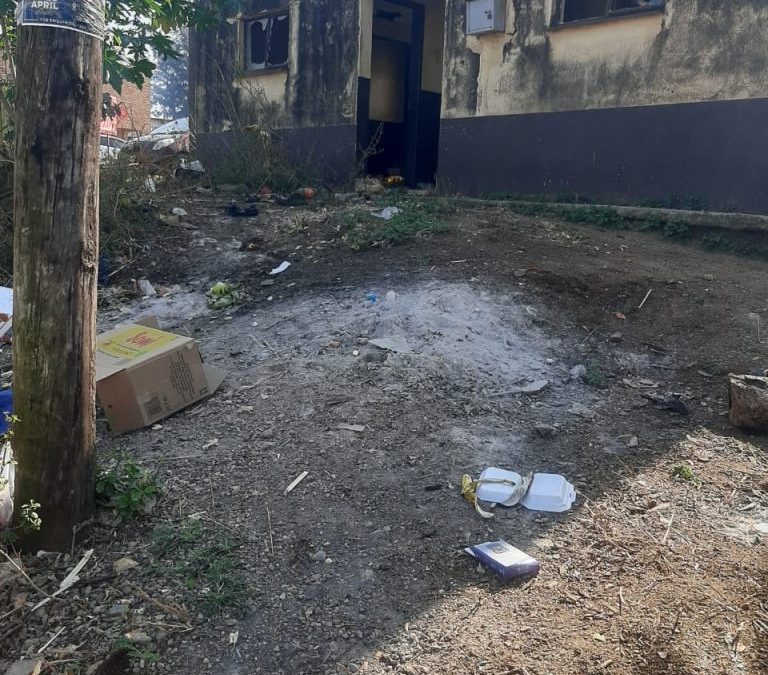
Luve functions as a town-like trading hub without a town’s services: no public toilet, no piped water, no waste collection. A World Bank-funded toilet stands derelict — and the constitutional deadline that would have fixed this expired 15 years ago.
All photos: Vuyisile Hlatshwayo
By Vuyisile Hlatshwayo
The story in brief
|
Luve is a major crossroads connecting Manzini City to the northern Matsamo Border Gate and north-eastern Mananga Border Gate with South Africa’s Mpumalanga Province. Across the road, street vendors are selling all sorts of wares under a makeshift plastic shelter. Nearby stands a derelict World Bank-financed building with broken windows, an empty JoJo water tank perched on a stand, and a remaining bottomless waste collection drum emblazoned with Ndlelayekuphila, the nickname of former Mkhiweni MP Michael Masuku, who donated it.
A street vendor, who spoke to Inhlase on condition of anonymity in fear of victimisation, says the rundown World Bank-financed building was meant to be a public toilet. But it was never opened to the public, she says, because of a since-resolved protracted chieftaincy dispute among factions within the Kutsimuleni royal household. It pitted the late Prince Maloyi’s inkhosikati (his widow) against rival princes. The building now shelters people living with mental illness, and doubles as an illegal dumpsite. She is, however, hopeful that the installation of Kutsimuleni Chief Mphelave will restore order and ignite long-overdue development in the peri-urban area.
When this Inhlase reporter visited Luve on June 25, he found a trading hub faced with a state-neglected sanitary crisis. For market vendors at Luve, it is a daily routine to bring containers filled with clean water from home, not only for safe drinking but also to offer customers the chance to wash their hands before and after eating. They say this town-like area lacks public toilets and piped water, posing sanitation and hygiene risks that lead to disease transmission, open defecation, and environmental contamination.
A town-like area without a town’s services
Situated in the Manzini region, Luve functions as a commercial node at a major crossroads connecting to the northern Hhohho and north-eastern Lubombo parts of Eswatini. Established in colonial times with one Ka-Ben store, a hammermill, and a marketplace, it has now grown into a bustling trading centre under the Kutsimuleni Chiefdom, with many shops, liquor outlets, butcheries, restaurants, building hardware stores, agro-dealers, bank ATMs, rental flats, and a lodge.
Despite this rapid growth, Luve is lagging behind in sanitary services, which the United Nations recognises as a basic human right. Its plight highlights 15 years of government failure to comply with Chapter XIII of the 2005 Eswatini Constitution: Section 218(1) provides for a single countrywide system of local government to bridge the urban-rural divide, and gave Parliament five years from the Constitution’s commencement to establish it. That deadline expired in February 2011.
A Luve market vendor, Khanyisile Zulu, explains the vendors’ plight. The lack of sanitary services, she says, threatens their informal businesses, especially since the Covid-19 pandemic left many customers health-conscious and wary of unsanitary conditions.
“Lack of toilets and water at Luve is an old problem which I also found when I joined our 15-member Sukumani Bomake Luve group some years back. We don’t have a public toilet and piped water. As a result, each one brings from home her own water for drinking and washing hands as well as to give customers who buy fruits to wash hands before and after eating,” she says.
As I interviewed Zulu, a kombi conductor came out to dump litter into the roadside storm drain and burn it. Pointing at him, she says that lack of waste collection services is another big challenge facing Luve residents, businesspeople, shoppers and commuters. She says they use open backyard pits to dump their waste, which they always burn once the pits are full. Each group of tenants in a block, she says, is allocated its own backyard space for a waste pit and pit latrine.
Luve businessman, Michael ‘Ndlelayekuphila’ Masuku, a former Mkhiweni Inkhundla MP, shares the vendors’ concerns. He reduces it to three challenges: sanitation, waste disposal and water. He highlights the lack of both a sewer system and designated waste disposal site as the major challenges. Mkhiweni Inkhundla, where Luve is located, generates 3,583.4 tonnes of waste a year, according to the Eswatini State of the Environment Report 2020.
“In this area, we don’t have a waste collection area to put our waste because burning it is a health hazard according to the health professionals and environmentalists. There should be a waste collection area and drums where a truck comes to collect the waste and transport it to a designated dumpsite,” he says. “In my case, I constructed my own waste collection area on my business premises where I dump all waste from my businesses. I use my van to transport it to the Manzini City dumpsite about 25km away from this area.”


The World Bank project that stalled
Inhlase has established that the public toilet was one of the World Bank-financed Mkhiweni Inkhundla projects that collapsed as residents’ objections and a decades-long Kutsimuleni chieftaincy dispute, since resolved, stalled the work, according to Masuku and the chiefdom’s headman. Eswatini took a US$26.9 million World Bank loan, approved in January 2011, for the Swaziland Local Government Project (SLGP, P095232), which started in 2013 and ended in 2019. Of that, US$7.76 million targeted eight of the country’s then 55 tinkhundla centres, while US$18.55 million went to urban local government.
Contacted in March 2025 by Inhlase about the then locked World Bank-funded Siphofaneni Market Shelter for women, Oarabile Minky Moilwa, World Bank Group Eastern and Southern Africa external affairs associate, confirmed the SLGP loan of $26.9 million to develop rural local governments (tinkhundla) and urban local government.
However, questions sent via WhatsApp to Ministry of Tinkhundla Administration and Development principal secretary, Nonhlanhla Dlamini, on 11 August about the never-opened Luve public toilet were only blue-ticked but unanswered at the time of publication.
Masuku remembers that the sewage site was opposed by some residents, who argued that the wastewater would contaminate the dam and the stream below, posing a health risk to residents who draw water from these sources. “I tried to construct a public toilet for both males and females, but it was badly managed. I also donated drums for waste collection, and the people removed and vandalised them. When I tried to get a sewage site, other residents complained that the faecal matter would be released into the dam and stream below, causing water contamination and waterborne diseases. People must learn to embrace development,” he says. The stalled World Bank-financed toilet project fell within his 2013–2018 Parliament term.
The businessman observed that while shop owners lock their toilets, passengers and shoppers are forced to use coping tricks and look for the nearest hidden places to relieve themselves. “I have a flushing toilet in my business place, and people flock there to use it. They always pretend as if they come to do business, but shortly, they then ask for a key to use the toilet,” Masuku says.

Ackel Zwane, a resident of Bhekinkosi area, 5.8km away from Luve, who shops at this trading centre, says he once experienced the embarrassing moment of wanting to use a public toilet in this trading centre. He recalls that he handled his situation by first buying meat from one of the butcheries to access its locked toilet.
“The pain of Luve”
When sought for comment, 65-year-old Kutsimuleni indvuna (chiefdom headman) Rogers Mamba, another former Mkhiweni Inkhundla MP, acknowledges the rapid growth of Luve from one Ka-Ben store to a peri-urban area, without piped water and sanitary services to keep pace. He attributes the challenges to the since-resolved long-running chieftaincy dispute and government’s ongoing failure to comply with the Constitution, which provides for a single system of local government countrywide.
According to the indvuna, several development projects approved by Libandla (chiefdom council) and Mkhiweni Inkhundla meant to improve the Luve business environment collapsed amid a protracted chieftaincy dispute. He says one resident fenced off a piece of land set aside for the sewer system, claiming that it belonged to him. He says this is one of the reasons that led to the collapse of the World Bank-financed Luve public toilet project.
Mamba adds that during his 2008-2013 Parliament term, he organised the Rural Water Department (RWD) of the Ministry of Natural Resources and Energy to sink a borehole to provide the Luve business community with piped water and a public flushing toilet. He adds that most of the Luve businesspeople have boreholes and charge people to use water on their premises. Shortly after sinking the borehole, he says, one resident who claimed ownership of the area filled it with stones, which led Mkhiweni Inkhundla to abandon the public toilet project. When Inhlase pressed him to reveal the names, he declined to name individuals lest they accuse him of political point-scoring.
“Surprisingly, those people who put stones into the drilled borehole also need the same service.” — Rogers Mamba, Kutsimuleni indvuna
“This is the pain of Luve and the ongoing struggles we are faced with as the people of Luve. When you bring development, other people see it differently. Surprisingly, those people who put stones into the drilled borehole also need the same service. But they saw it fit to stop the water project to serve their own self-interest,” he laments.
While still in Parliament, he says, he was able to convince the Eswatini Environment Authority (EEA), the Ministry of Tourism and Environmental Affairs parastatal, to provide drums and collect the waste. “I’d arranged with the Eswatini Environment Authority. It only continued for a while because it was something that I had organised while I was still an MP,” he recalls.
When contacted for comment, Belusile Mhlanga, Head of Environment Impact Assessment Monitoring & Evaluation, confirms the EEA’s efforts to address the waste-disposal challenges at Luve. She says, however, they stopped due to budgetary constraints and vandalism of the waste collection drums.
Mhlanga calls on emaSwati to comply with the Constitution, which makes environment protection mandatory for everyone. She cites Section 216(1) of the Constitution: “Every person shall promote the protection of the environment for the present and future generations.” Subsection 2 states that urbanisation or industrialisation shall be undertaken with due respect for the environment.
A new chief and an unopened toilet
Indvuna Mamba says Kutsimuleni Chief Mphelave, who was installed on October 22, 2022, has expressed serious concerns about the poor waste management system at the Luve trading centre. Consequently, he has set up the Cedusizi Dlamini-led Community Development Committee (CDC) to spearhead development in a chiefdom the dispute held back for decades. He charges it to address the Luve sanitary challenges including the opening of the public toilet.
“Since his installation, Chief Mphelave has hit the ground running, placing Luve challenges on top of his development agenda. In 2024, he took me to task after discovering that Lutfotja Mountain is being used as an illegal dumpsite. He enquired why some people care less for the environment. He has directed me to make sure that the culprits face the consequences for their environmental contamination and degradation,” he says.

Approached for comment, Dlamini, the CDC chairperson, says there should first be an environmental assessment of the Luve waste management problem to come up with a lasting solution. He adds that the opening of the public toilet is a top priority, emphasising the need for waste disposal services and a landfill like in the towns run by local authorities. He, however, stresses the importance of gathering information on the type of waste generated at Luve.
“The Bill is going slowly”
As a remedy, the two former lawmakers and the CDC chairperson call for upgrading Luve to town status. They say that it is long overdue amid its rapid growth outpacing the waste management system in the rural, town-like area. Both former Mkhiweni MPs blame the delay on the drafting — which they both participated in — of the Decentralisation Bill and Decentralisation Policy, 15 years in the works.
“The decentralisation is not done the way it was supposed to be done. If it [were] used the right way, we wouldn’t be here. According to it, there should be tinkhundla and imiphakatsi (chiefdoms) budgets to cater for their development needs. All these challenges would have long been addressed by our inkhundla or umphakatsi using its budget,” says former MP and indvuna Mamba.
Former MP Masuku blames the long delay on unspoken fears that local government would erode the chiefs’ traditional powers. The government, he says, seems to be struggling to secure the chiefs’ buy-in. Yet, the Constitution provides for a single local government system in which the Ministries of Tinkhundla Administration and Development and of Housing and Urban Development complement each other.
“The Bill is going slowly and it will be passed around 2030 if it were to be implemented. Apart from impacting on the powers of chiefs, lack of funds also contributes to the sluggish pace,” Masuku notes.
A cultural traditionalist, Mbho Elmond Shongwe, who authored the book The Intricacies in Eswatini, Politics, Culture, Development from 1900 to 6th September 2018, says chiefs have realised that the modern government structures are encroaching on their traditional powers. He blames government for urbanising the rural areas by pushing its local government agenda that, he believes, will upset the rural way of life of emaSwati underpinned by the tinkhundla philosophy.
“Why didn’t it zone the Luve business area rather than playing this catch-up?” — Mbho Elmond Shongwe, cultural traditionalist
“Government is wrong to use tinkhundla to govern because that disturbs emaSwati’s way of life. The original tinkhundla philosophy says only the people invite government to provide expert guidance and advice on home-grown socioeconomic projects without it dictating the terms,” Shongwe says. “This raises concern about its intention of transforming the rural life in chiefdoms into the chaotic township life. I wonder where government was when the unplanned development was designed and implemented. Why didn’t it zone the Luve business area rather than playing this catch-up?”
In response, Dudu Ndzinisa, director of decentralisation at the Ministry of Tinkhundla Administration and Development, acknowledges the long delays in finalising the Decentralisation Policy, noting that the Decentralisation Bill can only be passed into law once the policy framework is in place. She also admits that decentralisation requires a specific budget allocation for tinkhundla and imiphakatsi to bring the much-needed government services closer to the people.
She told Inhlase, for its companion report on Siphofaneni, that the ministry presented the Decentralisation Policy to Cabinet on June 4, 2026. Approval — and the budget line it needs — are still pending.
For now, Luve’s vendors will keep carrying water from home in containers — past a World Bank-funded public toilet that has never once opened its doors.
The numbers
|