
By Zwelethu Dlamini
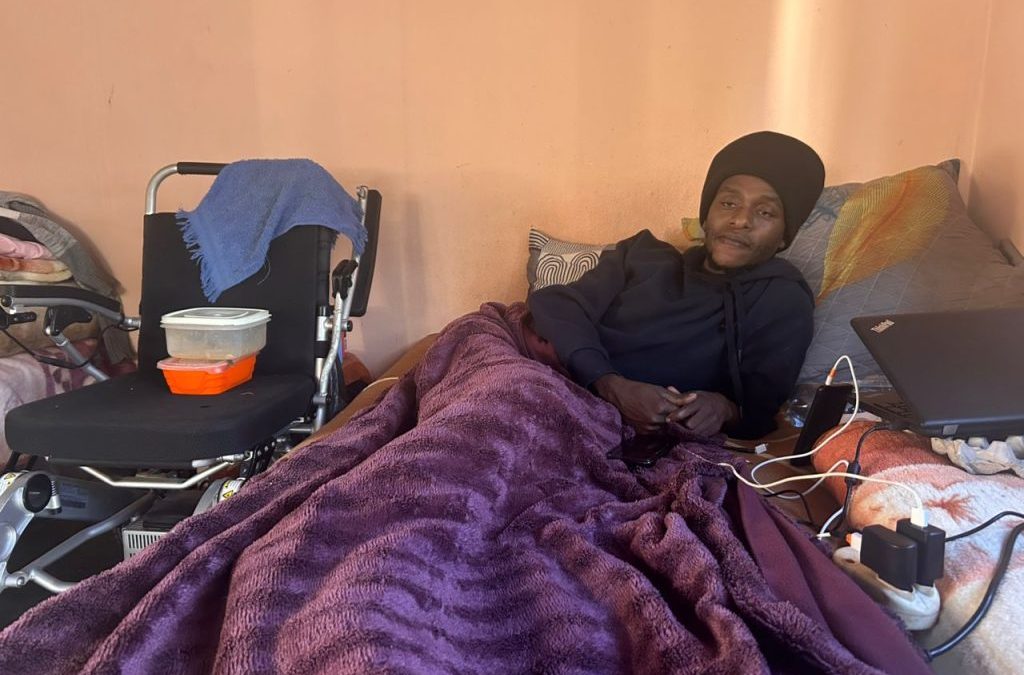
Every morning, Simanga Mndzebele wakes up knowing that the injury he sustained nearly five years ago has not only changed how he lives but also how he survives.
The 30-year-old, who was left paralysed after being heavily assaulted by members of the security forces during the June–July 2021 unrest, now spends most of his days in bed in a one room at his family home. Bed sores have required repeated surgery. He depends on relatives to help him with daily activities, while medical supplies such as catheters, urinary bags, dressings and medication consume most of the limited financial assistance available to him. The disability grant he receives from the Deputy Prime Minister’s Office goes toward covering part of his medical expenses.
“For the past two months I have mostly been in bed,” he said.
“The wounds are painful every day.” Hospital visits have become increasingly difficult because of the cost of treatment and the need to replace dressings regularly.
“If compensation came, I would start a business, maybe a piggery or cold-room project. I wouldn’t depend on people all the time.”
He estimates that he requires about E1,000 each month for medical expenses and another E3,500 for basic household needs.
“What is killing us is the silence,” he said.
“The government should speed up these cases. Some people are worse off than me. Some have no support at all.”
Nearly five years after the unrest, Mndzebele says he still has no indication when his case will be finalised.
The official record
The experiences of Mndzebele and other victims form part of a larger picture documented by several independent investigations.
On 29 October 2021, the Commission on Human Rights and Public Administration released a preliminary assessment of the June–July 2021 unrest.
The Commission verified 46 deaths, including two children, seven women, seven young people, two elderly people and 30 adult men. It also confirmed 245 gunshot injuries, including 22 people who sustained multiple gunshot wounds, and documented 337 arrests and detentions.
The Commission cautioned that those figures were likely incomplete because some injured people never sought medical treatment while other injuries were not properly recorded by hospitals.
Among other things, it recommended that the government carries out an independent investigation into the conduct of security forces during the unrest.
Five years later, that recommendation has not been implemented.

“I was only going to buy airtime”
Among those documented by human rights organisations is Machawe Lukhuleni, who was 16 years old when he was shot on 30 June 2021.
Lukhuleni, told Inhlase he had been sent by a relative to buy airtime in Lomahasha.
As he walked home, he encountered a confrontation between protesters and police.
He said people began running after police fired shots.
“I also ran,” he recalled.
“I fell. As I tried to get up, I heard another gunshot.”
He was struck in the back.
Doctors later told him the bullet had damaged his spine.
Read more: Police bullet confines boy, 17, to wheelchair
Today, Lukhuleni is a Form Five learner at St Joseph’s High School and uses a wheelchair.
Human Rights Watch documented his account in its 2025 report recording that he underwent surgery after the shooting and was told he had only a limited possibility of walking again.
Mothers waiting for answers and compensation for their killed children

For Thoko Sikhondze, the five-year anniversary marks another year without answers about the death of her son, Phumlani Sikhondze.
The street vendor is now raising her two grandchildren after her son was shot on 29 June 2021.
“My child was shot by OSSU officials while he was on his way home from work,” she said.
“He had spent the day fitting tiles in Mbabane and came back when the police did not want anyone in the streets.”
She said transport had stopped because of the unrest, forcing him to walk from Mbabane to Mvutjini only to be shot at on his way home.
The family initially took her son’s body to Mbabane Government Hospital, where they were told there was no pathologist available. According to Sikhondze, a soldier whose own brother from Gobholo had also been killed offered to drive them to Piggs Peak Government Hospital. She said a doctor initially declined to release the post-mortem results.

“The soldier insisted that they give us the report.”
According to Sikhondze, the report concluded that her son had been shot with a police firearm. She later joined other victims in meetings organised by the Swaziland Massacre Victims and Survivors Association (SWAVISA) for families pursuing legal action.
“There were lawyers assigned to us,” she said.
“We told them our stories. After that we only saw reports about some cases in newspapers, however I didn’t see my son’s case and did not know which lawyer was handling it”
Later, she sought assistance from human rights lawyer Thulani Maseko, who agreed to represent her without charge.
He asked her to return with the documents needed to institute proceedings.
“Unfortunately, he was shot that same week,” she said.
“That was the end of my case.”
“To this day I still do not know how I will get justice,” she lamented as she can’t afford a lawyer.
Another mother still waiting
Zanele Ndzinisa, Vice Chairperson of SWAVISA continues to seek accountability for the
shooting of her son, Lungelo Vilakati.
Vilakati, then a learner at Sitjeni High School, was shot by police during the unrest.
Ndzinisa said the family has continued following legal processes but has not received answers and compensation.
She said many families represented by SWAVISA continue to wait for updates on both criminal investigations and civil claims.
According to her, many victims last met lawyers in 2023, when statements and supporting documents were collected.
“Since then there has largely been silence,” she said.


Beyond individual stories
The experiences described by victims interviewed by Inhlase are also reflected in findings by independent organisations.
In its 2025 report, Human Rights Watch concluded that no member of the security forces had been held accountable for deaths and injuries arising from the June–July 2021 unrest, despite repeated calls for investigations. “This report, based on 15 interviews conducted by Human Rights Watch in 2025, corroborates findings previously published by Human Rights Watch that the Royal Eswatini Police Service (REPS) and the Umbutfo Eswatini Defence Force (UEDF) not only improperly used teargas, and rubber bullets, and physically assaulted civilians during the June 2021 unrest, but also shot indiscriminately at protesters and passers-by with live ammunition, killing scores of protesters and injuring hundreds more, including children. Additionally, it shines the spotlight on the absence of accountability since then and the precarious and desperate situation of victims of security forces’ abuses in 2021, calling for urgent action to be taken to remedy this,” the Human Rights Watch reported last year.
In its 2026 submission to the United Nations Human Rights Council’s Universal Periodic Review of Eswatini, the International Commission of Jurists (ICJ) stated that although Eswatini had accepted recommendations during previous United Nations human rights reviews relating to accountability, judicial independence and investigations into human rights violations, there had been “little, if any, progress” in implementing those commitments.
The ICJ further noted that the Commission on Human Rights and Public Administration had recommended prompt, independent investigations into the deaths and injuries documented during the unrest, but that those recommendations had yet to be implemented.
“The Commission recommended that the authorities initiate prompt, independent, impartial and transparent investigations into allegations of the death of civilians at the hands of security agents during the unrest of June 2021, with the objective of bringing those responsible to account and providing reparations to families of victims. Eswatini has yet to make any progress in initiating such a process or implementing any of the Commissions’ other recommendations,” reads paragraph 28 of the report.
“A similar situation persists in respect of the well-documented assassination of human rights defender and lawyer Thulani Maseko in January 2023. Despite repeated calls for independent investigations into Mr Maseko’s murder, no progress has been made to date. In an interview conducted during the preparation of this submission, Mrs Tanele Maseko, the wife of the late Mr Maseko, indicated that despite repeated attempts to follow up with the relevant investigating officers, they reported no progress regarding the investigation, even with respect to preliminary findings, such as ballistics or pathologists’ reports. The impression Mrs Maseko is left with is that the investigation is either not proceeding at all or is not a matter of priority, further reads the submission by ICJ.
The questions that remain
Five years after the unrest, many victims continue to live with permanent injuries, families continue to mourn relatives who were killed, and court proceedings remain unresolved.
Their experiences raise broader questions about what has happened to investigations, compensation claims and legal proceedings arising from the unrest.
In the next part of this investigation, Inhlase examines how civil society organisations documented approximately 300 respondents after the unrest, how 93 civil claims were eventually prepared for litigation, why only seven lawyers remained to pursue those cases, and what lawyers say has contributed to delays in both civil and criminal proceedings.