By Zwelethu Dlamini
A new international human rights assessment has found that Eswatini is failing to adequately protect both the socio-economic wellbeing and fundamental freedoms of its citizens, with the country ranking among the worst performers in the region on key civil and political rights indicators.
The findings are contained in the latest dataset released by the Human Rights Measurement Initiative (HRMI), an independent global organisation that tracks governments’ human rights performance.
According to the report, Eswatini scored only 67.2 percent on HRMI’s Quality of Life Index, which measures governments’ fulfilment of rights related to education, health, food, housing and work.
The score indicates that Eswatini is achieving only about two-thirds of what should be possible given the country’s available resources.
HRMI argues that under international human rights standards, any score below 100 percent suggests a government is failing to fully meet its obligations to progressively realise economic and social rights.
“The right to access social necessities without discrimination is fundamental,” said HRMI Co-Executive Director Thalia Kehoe Rowden.
“Eswatini’s leaders will need to make significant changes to improve their people’s quality of life. The good news is that the country already has sufficient wealth to make substantial improvements to people’s lives.”

Concerns over state violence
The report also raises concerns about state violence and repression.
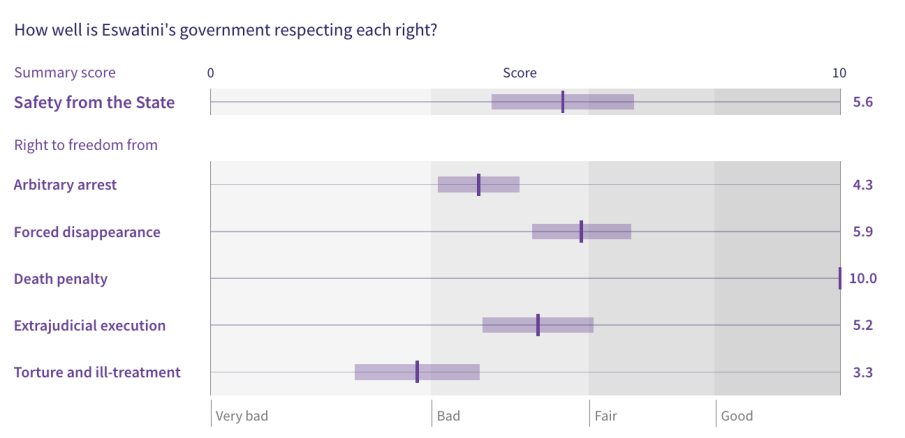
Eswatini received a score of 5.6 out of 10 for “Safety from the State”, a measure that assesses the extent to which people are protected from violations such as torture, arbitrary detention, extrajudicial killings and enforced disappearances.
Human rights experts consulted by HRMI identified human rights defenders and peaceful protesters as groups frequently targeted by the state.
While acknowledging that Eswatini has abolished the death penalty, the report states that individuals perceived to oppose the government continue to face arbitrary and politically motivated arrests and detention, torture and extrajudicial executions.
The findings come amid ongoing scrutiny of the country’s human rights record following the deadly pro-democracy unrest of 2021 and subsequent allegations of excessive use of force by security agencies.
Freedom of expression among lowest in Region
Perhaps most concerning is Eswatini’s performance on civil and political rights.
The country scored 2.9 out of 10 on HRMI’s Empowerment Index, which measures rights including freedom of assembly, freedom of expression and political participation.
The assessment found no measurable improvement in these rights during the three years that HRMI has tracked Eswatini.
On the specific right to freedom of opinion and expression, Eswatini scored 2.5 out of 10, placing it last among nine countries assessed in the Sub-Saharan Africa comparison group.
“The absence of progress in Eswatini’s civil and political rights scores over several years should be a concern not only for the people of Eswatini, but for the region as a whole,” said Nkosi Sibanda, HRMI’s East and Southern Africa Engagement Lead.
“The ability to speak freely, organise peacefully, and participate in public affairs is central to sustainable development and accountable governance. Our data suggest that too many people in Eswatini continue to face significant barriers in exercising these fundamental rights.”h
HRMI’s Rights Tracker compiles annual human rights data using a combination of expert assessments and internationally recognised socio-economic indicators.
The 2026 dataset measures 14 civil and political rights across more than 50 countries and five economic and social rights across 200 countries.
The organisation says its data are used by institutions including Amnesty International, the United Nations and the World Bank.
The findings are likely to add to growing international attention on governance, accountability and civic freedoms in Eswatini, where calls for political reforms and greater protection of fundamental rights continue from civil society organisations and pro-democracy activists.